In Ohio, there is a place offering a New Year's Day drag show that has a strange rule about being slower every year since it began.
For this year's Hangover Nationals at Dragway 42 in Ohio, the rule is 20.21 seconds -- more than two-tenths slower than what it was when it started.
The drag competition is held in all weather conditions and with street driven cars. The object of the race is a bracket event. A decade ago, the race was run with a 20.11 second index. As is a sportsman event, the Christmas Tree counts down bulb every half second (unlike a Pro tree, which lights all three in four-tenths of a second) before going green. People actually count seconds to ensure they are going no faster than the index. If you're faster than the index, you are disqualified unless the opponent rings up the red light or crosses a boundary line. If both drivers are faster than the index, the slower car (closer to the index time) wins because it is closer to the index.
Outside the Autodromo Enzo e Dino Ferrari, outside the Variante Tamburello chicane, is a statue where many flowers and Brazilian flags are placed every year, but none more prevalent day than May 1. It was 1417 CET (8:17 AM EDT) when it happened, twenty-five years ago today.
Newly inducted Class of 2019 Indianapolis Motor Speedway Hall of Fame inductee Bob Jenkins that afternoon offered a tribute during the broadcast of the Alabama 500 (clip of opening the tribute of silence, which was interrupted by the second Big One). It also includes the Earnhardt interview.
In 1964, Gurney was part of this commercial, which included the fact he had won the first of what we call the Monster Energy NASCAR Cup Series race at Riverside, California a year prior, for the legendary Wood Brothers of Stuart, Virginia, a team that is still owned by the family, though they are now a satellite team to Penske.
In 1970, he was part of Chrysler's SCCA Trans-Am efforts:
In the 1980's, Dan ran the Toyota sports car efforts, and ran both the Over 2500cc and Prototype car efforts under the All American Racers platform. Toyota did a few ads with him, his wife, and one son.
And a few current owners of Dan's great racers take their laps on contemporary tracks:
Toyota GTP:
1972 USAC MCT Offenhauser:
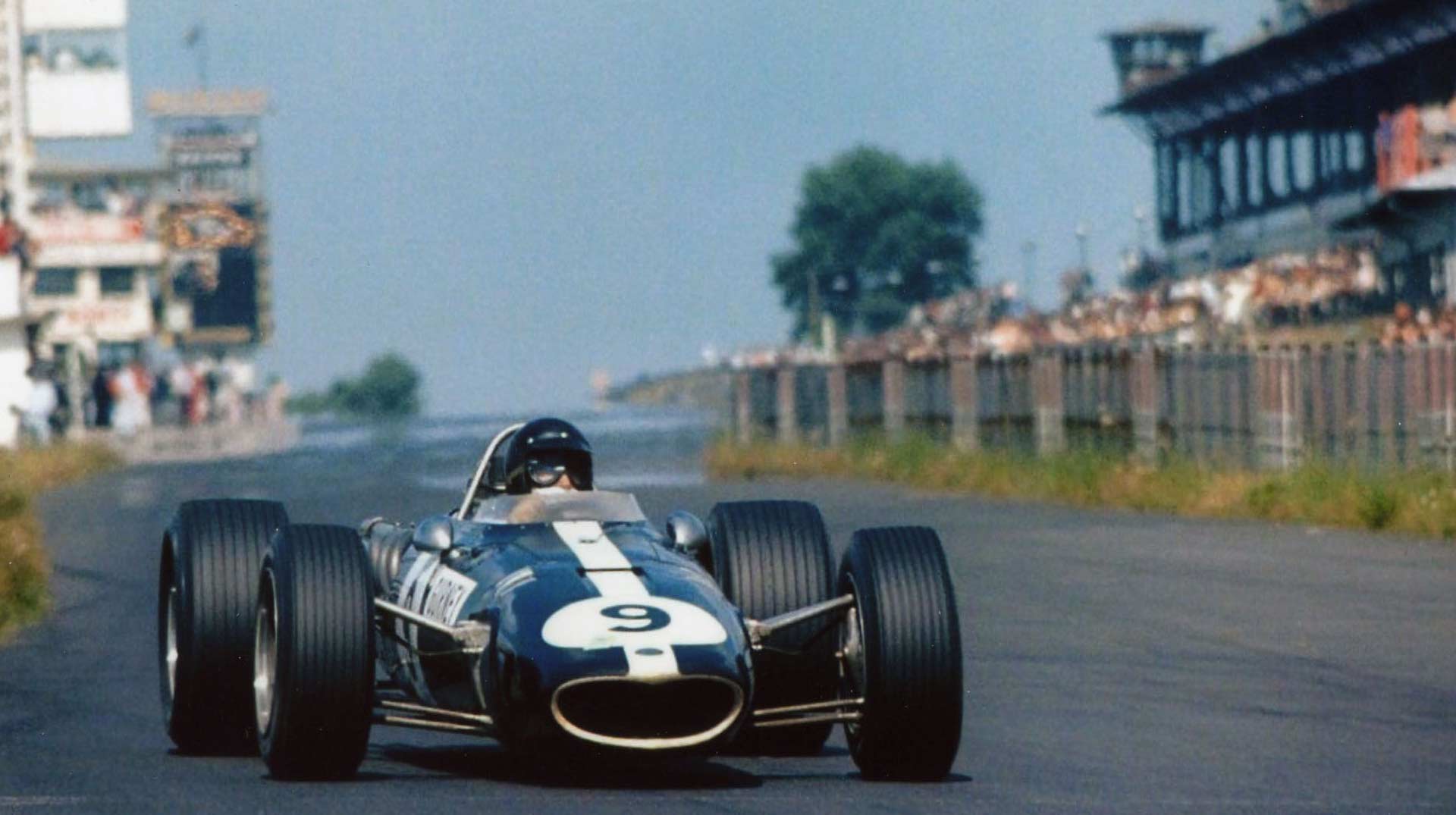
And the historic car at a historic track: 1967 EagleF1 Spa winner at Goodwood:
During the election season, we referenced a 1964 Car and Driver article regarding a mock Presidential candidate in a popular motor racer. When we researched archives further, we were able to note some very interesting series of photos that I found connected that legendary motor racer and a current motorsport superstar. Can anyone note the reference?
The news of Audi's exit from the FIA World Endurance Championship and the signature 24 Heures du Mans reminds us of the decision Volkswagen of America and Intersport to use an off-season NFL Films staff to do the Truth in 24 series regarding the French endurance classic.
What sticks out is how NFL Films took the techniques that the Sabols used for NFL head coaches and transferred it to the engineers of Audi in the French endurance classic. Howden Haynes and Leena Gade became stars in their own right (and Volkswagen used Gade in a series of commercials) from the NFL techniques, which in the first film was not approved until the final 20 minutes before the race -- yet it was the NFL that gave Audi it's greatest moments by celebrating engineers, not the drivers.
For the second consecutive Indianapolis 500, tragedy has struck the Field of 33. An accomplished driver who made multiple Indianapolis 500 starts has been killed in a racing crash.
Three-time “500” starter Bryan Clauson (#88 Dale Coyne Racing Jonathan Byrd's Catering Honda) died Sunday night from head injuries from contact after a violent flip at the Belleville (KS) Midget Nationals A-Main at the North Central Kansas fairgrounds in the said city. On Lap 14 of the 35-lap A Main, during a battle for the lead the half-mile high-banked dirt track, Clauson, a three-time winner of the event battled Chad Boat, son of former Verizon IndyCar Series race winner Billy, for the lead when, in a classic dirt track “jumping the cushion,” his midget climbed he armco guardrail, flipping violenly and hit by Ryan Greth. Clauson was transported to a Nebraska hospital where he died the next evening. Clauson is the fifth Indianapolis 500 starter since 2000 to be killed in a crash from a motor racing incident.
The Midget Nationals, since 1978, has been won by six Indianapolis 500 starters and five current NASCAR national series drivers, including three current Sprint Cup drivers (#5, #42, #88).
Sunday is probably the premiere day of the year for auto racing fans. No, scratch that - it is the premiere day, Christmas, New Year's and your birthday all rolled up into one. It starts Sunday morning with the world's most glamorous and prestigious race, the Grand Prix of Monaco (6:30 am CT, NBC), run through the streets of Monte Carlo before all kinds of royalty and celebrity. It continues with America's most famous race, the Indianapolis 500 (10:00 am CT, ABC), somewhat tarnished to be sure, but newly on the upswing as it approaches its 100th running. And for a nightcap there's NASCAR's longest race, the Coca-Cola 600 (4:00 pm, FOX), which starts in the late afternoon and ends under the lights.
With all that, it seemed like a good idea to take a look at Hollywood's treatment of the sport. Not surprisingly, there are movie conventions that find their way into almost every racing film. There are also reminders of why so many people become addicted to cars driven fast and lives lived even faster. Herewith, five films to check out if you need a warm-up for Sunday.
LeMans (1971) Steve McQueen, lots of cars
In the late 60s, the famed 24-hour endurance race became a focal point for American racing. The Ford Motor Company put on an all-out blitz to break the European stranglehold on the race and become the first American manufacturer to win. The biggest names in American racing, drivers such as A.J. Foyt and Dan Gurney, raced at LeMans, and Wide World of Sports presented live via satellite coverage of the beginning and end of the race.
It was in this climate that Steve McQueen’s LeMans appeared. McQueen played Michael Delaney, an American driver returning to the race that almost claimed his life in a fiery crash that did kill a fellow driver and friend. McQueen’s need to come to terms with the past, as well as the inevitable romantic entanglements of the present, provided the backdrop for this often moody story that does a pretty good job of describing the thoughts of a man whose profession forces him to confront death on a regular basis.
There was almost more action behind the scenes than on the screen. McQueen was already an avid race car driver, and LeMans was his dream project – so much so that he put his own money and prestige behind it as producer. He fought the director, John Sturgis, for control of the project – Sturgis wanted to focus on the love story, while McQueen wanted the race itself to be the star. The movie’s budget skyrocketed, much of the original action footage proved unusable, and one of McQueen’s financial partners threatened to shut down filming altogether. Eventually, McQueen was forced to give up his salary, percentage of profits, and future royalties in order to complete the film. Not surprisingly, the enterprise resulted in financial bankruptcy for McQueen.
Notwithstanding the problems, LeMans contains wonderful footage of the famed race. At a time when most people had seen LeMans only in newsreel footage or on television, the big screen provided a magnificent panorama of the sights, sounds and colors of one of the world’s greatest races.
Interesting note: there is no dialogue for the first half-hour. The engines say it all.
Bobby Deerfield (1977) Al Pacino, Marthe Keller
As was the case with LeMans, Bobby Deerfield deals with an auto racer struggling to deal with a deadly crash. Like Steve McQueen’s Delaney, Al Pacino’s Deerfield must overcome the psychological impact of death; and like Delaney, Deerfield is drawn into a relationship with a woman dealing with her own demons. Think of it as Love Story with really fast cars.
That’s not really a fair assessment, however; although Bobby Deerfield disappointed many race fans who were expecting a movie in the mold of LeMans and were turned off by the movie’s incursion into soap opera, it eventually won praise as an incisive, underplayed character study. Pacino himself considered Deerfield to be one of his best performances from that era. While the race footage (from the 1976 Formula One season, featuring Mario Andretti, among others) isn’t perhaps up to the standards of LeMans or Grand Prix, it still packs a punch on the big screen.
While Bobby Deerfield may have failed to capture the drama on the track in the same way as LeMans had, it was a decidedly more peaceful filmmaking experience. There were no power struggles on the set, no creditors threatening to pull the plug, no tensions between the star and the director. Pacino and Keller created a credible chemistry on-screen, a chemistry they took off-screen as well.
The Big Wheel (1949) Mickey Rooney, the Indianapolis Motor Speedway
OK, so The Big Wheel isn’t going to win any prizes. The story is a typically clichéd sports melodrama, the story of Billy Coy (Rooney), the son of a race car driver who is killed in a fiery crash at the Indianapolis 500. (Do you notice a theme running through these movies? Racing movies are definitely not for the faint of heart.) Coy is determined to win the race that claimed his father’s life, and nothing is going to stop him – including a fire that engulfs his car in the climatic final scene.
Oh, and along the way there’s romance, conflict, and angst as well. “Restless! Reckless!” proclaims the DVD cover, and that’s about all you have to know. Rebel Without a Cause with really fast cars on a track that goes around and around.
This was one of Mickey Rooney’s first “adult” roles after his success with Andy Hardy, and while the plot isn’t anything to write home about and the special effects are pretty hokey (come on, that really isn’t Rooney behind the wheel of a burning car, is it?), this is still a movie to be included in the list. For one thing, it takes place at the Brickyard, and the racing footage goes a long way to capturing the look and feel of the Indianapolis 500 as it was back in the day, when the race was literally an all-day affair, a Memorial Day celebration that was equal parts sports spectacle and county fair. This is Indy as it really was – the wooden grandstands festooned with flags and bunting, the cars that were often little more than coffins on wheels, the skill and courage required by driver and mechanic alike to reach the finish line in one piece.
Anyone watching this movie who is only familiar with modern-day racing will be stunned – and educated – by how far the sport as come. It is more sophisticated, less primitive, not nearly as dangerous; but there’s also something more antiseptic about it, and that isn’t necessarily a good thing. Combine it with 1939's Indianapolis Speedway with Pat O'Brien and John Payne, and you'll get a pretty good sense of the rich history of the Indianapolis 500.
Winning (1969) Paul Newman, Joanne Woodward, Robert Wagner
Winning is a throwback to another era, that of the all-around racer. Before the age of specialization, of corporate sponsorship of entire racing series, race car drivers were content to compete in anything that had four wheels. In Winning, Frank Capua (Newman) and his chief rival, Luther Erding (Wagner) battle in sports cars, stock cars and open-wheeled cars, with a climactic finish at the Indy 500.
There are no fiery crashes in Winning, although there is a spectacular pileup at the start of the 500 (the exciting race footage comes from the 1966 contest, which featured a 17-car melee on the first lap). The accident, in which there were no serious injuries, serves to shrink the field, making the one-on-one battle between Capua and Erding that much more intimate. Think Ben Hur, with really fast chariots and no horses.
There is a love story, of course – in this case a triangle involving the two drivers and Elora (Woodward), Capua’s wife, who finds Capua becoming more distant as he struggles to overcome a career slump. There’s also tension between Capua and his sponsor, who turns to Erding when Capua seems washed up. These hackneyed conventions are made more tolerable by the surprisingly affecting relationship between Capua and his stepson (played by Richard Thomas), who finds in Frank the father he never had, and works hard to bring Elora and Frank back together. In the end, it works.
This movie owes everything to Paul Newman. It was originally conceived as a television movie, but the participation of Newman and Woodward elevated it to the big screen. It elevated it in other ways as well; Newman has always been the kind of actor who could take a B concept movie and somehow make it more than the sum of its parts (see the otherwise routine Harper detective movies, for example). Newman, like McQueen and other racing buffs, had little time for the romantic elements of the plot; it was the fast driving that turned him on. Always a fan of racing, it was here that he learned to drive competitive cars, and his love of the sport translated into a second career as a professional racer.
Interesting note: Dave Grusin, who did the music for Bobby Deerfield, scored Winning as well.
Grand Prix (1966) James Garner, Yves Montand, Toshiro Mifune
The Tiffany of racing movies, Grand Prix has it all. Director John Frankenheimer spent the season on the Formula One circuit, and his innovative camera mountings on the cars presaged the in-car cameras that dominate televised racing today. Frankenheimer combined this with a multishot approach to editing that often turned the screen into a montage of multiple angles and storylines running simultaneously. The result was a visual masterpiece of breathtaking racing action in a widescreen setting, which won the film three Academy Awards for effects.
For Formula One fans, Grand Prix sounds an often nostalgic note, vividly capturing many of the old European circuits that used to run along treelined public roads, with spectators standing perilously close to the track. Many of these are no longer used in Formula One, replaced by modern, more compact circuits designed to keep both the fans and the drivers safer. Safe they may be, but they’re often also flat, dull, and without much in the way of character. In Cars at Speed, his magnificent book on the Grand Prix circuit, Robert Daley mentions that auto racing’s early appeal often laid in the fact that spectators could envision themselves on the same roads as the racers, an illusion shattered with the man-made circuits of today.
While the racing action dominates Grand Prix, there is a story as well, that of four drivers battling for the Formula One championship: Garner, the American banished from Lotus for reckless driving, seeking redemption with Mifune’s new Japanese team (Garner, like McQueen and Newman, would take up racing as a serious sideline) ; Montand, the aging Ferrari champion looking for one final title while struggling with an altered perception of his sport; Brian Bedford, Garner’s former teammate, dealing with the twin specters of a near-fatal accident and the legacy of his late brother, also a world champion; and Antonio Sabato as the young Italian driver who lives only for the moment, understanding that life on the edge is what makes the whole thing worthwhile. There are, naturally, romantic triangles and fiery crashes – but without them, where would a racing film be?
Even in the somewhat soapish subplot, Grand Prix manages to sound the right notes, allowing the characters the opportunity to talk about how they cope with a job that requires you to put your life on the line every moment. The common theme is that of fatalism: you choose what you do for a living, you find a way to rationalize what happens, you live with whatever consequences may develop. You’re conscious of the risk, but if you think about it too much (as Montand’s character does in the second half of the film), you become paralyzed by it and lose the edge that keeps you alive. Phil Hill, the former world champion who appears in a bit part in Grand Prix, once said that a race driver expects to die behind the wheel. But he had thought about it so much, it no longer had any meaning for him: “I don’t believe in the law of averages. A driver makes his own averages.”
Bonus: Since I wrote this piece back in 2008, there emerged a movie that surely would have earned a spot on this list: Senna, the remarkable 2010 documentary on the life and death of the great Ayrton Senna, directed by Asif Kapadia.
The movie uses no voiceover narration, preferring instead to allow the participants themselves, along with announcers in various race footage, to tell the story of the young man from Brazil who rises through the ranks to become world Formula One champion. And Senna's story is not an easy one: his fierce rivalry with teammate and nemesis Alain Prost, his battles with F1 officials, and his role as a icon to his Brazilian countrymen - the one person in a poor and corrupt country in which they can take pride.
Kapadia succeeds in creating a deepening sense of foreboding; of course, the threat of death is never far removed from the world of motor sports, and as we approach the fateful 1994 San Marino Grand Prix, we see Senna, in an unreliable and difficult-to-control McLaren, being told by his close friend Sid Watkins, the F1 medical director, that the two of them should just chuck it and go fishing. I can't, Senna tells him, although there is no reason why he can't: multiple world championships, more money than he could possibly need, and already a status as one of, if not the, greatest grand prix champions of all time. Wisely, the film doesn't dwell on Senna's fatal accident, coming one day after the death in practice of fellow driver Roland Ratzenberger and two days after Rubens Barrichello had barely escaped being killed in practice. The crash is shown only once, but it is enough. It is, as The Sun's critic Alex Zane says, "fascinating and profoundly moving."
It may be 52 years later, and two years after a well-celebrated return to the Brickyard of the child of another driver killed at the Indianapolis 500, but according to Angela Savage, she is inviting (and they have accepted) Sherry MacDonald, widow of Dave MacDonald, killed in Black Noon at the 1964 Indianapolis 500, who has never returned to the Brickyard since then (though Eddie Sachs, Jr has returned to the track in the past), and their son Rich to the Brickyard for this year's Centennial 500.
Angela and Rich have been seen together at various motor racing events representing their fathers, most notably at the NASCAR race in Las Vegas.
(PHOTO: Angela Savage and Rich MacDonald at the USRRC Hall of Fame in California in the spring. Both fathers were inducted, and this is a shot of the two children together.)
Postponed from an earlier date because of the ABC Supply 500 tragedy. Writer's note -- this was the article that I have considered would make for some work to include the Peacock logo history, as NBC is using the older logos for the Rebel 500. Maybe the Peacock logo history fits for a further article.
So the MDA has ended their once-21 hour telethon after cutting it to just a few hours on network television. So it's time to find something new for Labor Day on television, and NBC is doing so with the Rebel 500 NASCAR Sprint Cup Series event at Darlington Raceway in the Florence, South Carolina region. (Please read here and here in order to understand the history of Darlington's spring race that has been moved to this date for 2015, and why it is referred as the Rebel 500.)
For the Rebel 500 September 6, the first time Darlington Raceway will run on the Sunday before the first Monday in September since 2003, the circuit and teams are promoting various retro-themed promotions. Various sponsors are using schemes with corporate images from the past, as many sponsors are using logos of the past, and some teams are basing liveries on famous liveries of the past, while Ingersoll-Rand, Competition Cams, Moog Chassis Parts, 3M, among other NASCAR contingency sponsors, are using their past logos for stickers. Even NASCAR and NBC have joined in the theme, with retro logos being used by both for the event. But as this blog discusses the moving picture arts of the past frequently, NBC's logo has joined the fray.
The Peacock logo used in this ad is authentic 1960's, but too, the NBC promos for the race include "when Carson was king". Some are even wanting NBC to use classic logo mic flags for the broadcast to fit with the entire retro theme of the race, the first time the Florentine circuit has organised a race on this date since 2003, when the fall race (now at Fort Worth, Texas, because of Ferko) was run there. (In 2004, the circuit moved the fall race to November, but lost it after a lawsuit.) Even some on Twitter are playing fun, asking of Messrs. Scheweiger, Burton, or Letarte will wear 1970's themed clothing to join the entire party.
And this wasn't their first 1970's themed video for the 2015 season. Earlier in the year, this promo was cut by drivers, featuring another 1970's theme. Can you identify the 1970's theme in this video?
I was intending to comment on a fun 1970's themed promotion that fits within our television blog that NBC has been airing for an event next week, but sadly, I have to postpone that commentary. As I write this at 2120 hours Eastern time on a Monday night, a message has been sent by the Indianapolis Motor Speedway with a press conference by Mark Miles of INDYCAR. The news conference was requested by Julianna Wilson and her family to be held in Indianapolis, and it was the worst news that could happen following Sunday's ABC Supply 500 at the Igdalsky family's Pocono Raceway.
Mr. Miles announced just after 2100 hours EDT tonight INDYCAR driver Justin Wilson died of his head injuries after his helmet was struck by an errant nose cone from Sage Karam's car that had impacted the Turn 1 wall at Pocono Raceway on Lap 180.
The freak incident that has many, including NBC's Townsend Bell, asking is it time for canopy cockpits, similar to an Unlimited Hydroplane or a Top Fuel racer. James Hinchliffe was knocked out for a time after the 2014 Indianapolis road course race, and as we know, Felipe Massa had an injury when a spring on another race car penetrated into his visor during the Magyar Nagydij in 2008. With the tragic circumstances at Pocono, the questions regarding canopies in single-seaters will come up again. John Surtees (F1 world champion 50 years ago) lost his son Henry to a crash a few years ago when an object struck his helmet in an FIA F2 race.
Mike Joy: "Incredibly sad . . . within a fortnight racing loses both of our 'gentle giants.'"
A. J. Allmendinger: "My friend, brother, teammate, and especially to one of the most amazing people I have had the pleasure to be around." (Allmendinger has posted a Wilson photo on his Twitter profile.)
Sage Karam (whose crash led to the debris that led to the fatal crash): "I can't find the proper words to describe the pain and sympathy I feel for Justin and his family."
The humility in the paddock tonight is poignant in light of the news. To the Wilson family:
Réquiem ætérnam dona eis Dómine; et lux perpétua lúceat eis. Requiéscant in pace. Amen.
Eternal rest grant unto them, O Lord; and let perpetual light shine upon them. May they rest in peace. Amen.
Somewhere in the recesses of time there’s a memory of a newspaper picture of a spinning race car. Possibly it was this picture or one like it, which I would have seen in the Sports Peach* of the Minneapolis Sunday Tribune.
*So called because, in order to make it stand out from the rest of the Sunday paper, it was printed on peach-colored paper. Distinctive, though it didn't do much to enhance the clarity of photographs.
For whatever reason - perhaps the obvious, that the car was clearly going in the wrong direction when contrasted with the other cars in the photo - the memory of that picture (as opposed to the picture itself) has stayed with me, frozen in its own moment, from that day on. My four-year-old self didn't know quite what it meant, but I knew for sure that it wasn't good.
There would have been another picture from that Sunday’s paper, something like this one, it's meaning much easier to understand:
The photos, and many like them, were taken on May 30, 1964, at the conclusion of the second lap of the Indianapolis 500, and the worst part of that picture above is that it doesn't even show the worst part of that crash. What you see there is the moment of impact when Dave MacDonald’s car struck the inside wall and exploded; the car then skidded across the track, where it was in turn struck by Eddie Sachs’ car, causing an even greater fireball, its smoke completely enveloping the corner of the track, making it impossible to continue. The race was halted for nearly two hours, the first time anything other than rain had stopped it. Sachs was killed instantly*, and MacDonald died a couple of hours later from the burns he’d suffered.
*Hard as it may be to believe, it’s likely that Sachs was not burned to death, as initial reports stated, but instead was killed as the result of “blunt force injuries” from the impact of the crash.
I could have found better pictures of the crash, ones that present the horror of the day with more clarity, but I chose those because they were how the event entered into my consciousness. These were the days when the Indianapolis 500 was still a major, almost mythic, event in American sports. The race was not yet carried on live television (though 1964 did mark the first of seven years in which it was broadcast via live closed circuit to theaters across America), and save for the few minutes of highlights that might appear on the following Saturday's Wide World of Sports*, the sole contact to the race was the live radio broadcast, hosted by the great Sid Collins. For those who couldn't afford to go to the theater and didn't have the patience to listen to the radio for hours, the only entrance to this mysterious world set in far-off Middle America was the next day's newspaper.
*ABC's live TV broadcast has only been around since 1986. No doubt it gives one a more detailed view of the 500; at the same time, it greatly diminishes the race's mystique.
And so these pictures, or ones like them, were how I first learned about Eddie Sachs, one of the greatest drivers never to win the 500, and Dave MacDonald, a rookie at Indy but a great sports car driver in his own right; men of accomplishment who deserve better from me than to be immortalized in my memory as joint headliners in one of the darkest days in the history of the Indianapolis 500. Jim Taylor, a columnist for the Toledo Blade, from which these photos came, described how "The fiery crash chilled a monstrous crowd estimated at 325,000 people who were suddenly quiet and solemn in the face of one of the worst tragedies in the history of this old, old track." Some, witnessing that crash, never attended the race again.
The pictures fascinated, but did not traumatize, me.
***
I may have mentioned this before, but auto racing was among the first sports that I came to love, my aunt buying an inaugural subscription to Stock Car Racing magazine for my birthday in May 1966, less than two years after the Sachs-MacDonald crash.
In May 1967 Lorenzo Bandini was killed during the Formula One Grand Prix of Monaco when his car crashed and exploded. He did not die immediately, but three days later succumbed to the injuries caused by the burns. Aside from that, the crash resembled, at least superficially, the one that had happened at Indy less than three years before. This time I saw the crash a week or two later on Wide World. Other than possibly giving me a slight fear of fire, of history repeating itself, it did not dissuade me from watching future races. A month later, again on Wide World, I would see A.J. Foyt, one of the racing heroes of my youth, win his third Indianapolis 500. His second victory had come in 1964, the race in which Sachs and MacDonald were killed.
It bears repeating: auto racing was and is a dangerous sport. But as technological and psychological changes have evolved, the sport has become that much safer. Dale Earnhardt, Ayrton Senna, and Dan Wheldon, great drivers who were the most recent to be killed in their respective racing disciplines, remind us that death is always a present companion, one that maintains the ability to shock.
In 1964 auto racing was dangerous enough that the aforementioned Toledo Blade presented a kind of macabre box score detailing the types and severity of injuries that had occurred during the race. I don't know whether or not this was a regular feature every year, but its appearance reinforces the impression that such risks were an understood, if not welcome, aspect of the sport.
Phil Hill, one of the greatest of racing drivers and the first American to win the Formula One World Championship, once said that drivers of his era (late '50s, early '60s) expected to die in a racing accident. He was matter-of-fact when he said it. It was the thrill, the adrenaline rush that came from the combination of speed and competition, that made them who and what they were, and made acceptable the risk that accompanied racing. Sachs himself once said that "in the long run, death is the odds-on favorite." Bobby Unser called survival a 50/50 proposition.
Today we look at things differently: we shield our heads in helmets when riding a bicycle, we use antibacterial soap to wash our hands, we beg the government to save us from the dangers of food and drink. Yet, as the newsman Harry Reasoner once said, for all the efforts man makes to avoid risk, "he may get one day extra or none; he never gets eternity." It echoes the words Sid Collins spoke after the announcement of Sachs' death had been made on the radio broadcast. "We're all speeding towards death at the rate of sixty minutes every hour," he said. "The only difference is that we don't know how to speed faster, and Eddie Sachs did." Sachs died driving his racing car and, concluded Collins, who knew the man and the racer, "I assume that's the way he would have wanted it."
The relative safety of auto racing today has induced, if not overconfidence, a kind of complacency about the sport's ever-present danger, in fans if not in drivers. People who are not racing fans think that many of those who are come to see the crashes, in the same way that hockey fans come for the fights, though I have never been that kind of fan. Some think the emphasis on safety has been to the overall detriment of the sport and its competitive nature, that back in the day drivers enforced a kind of self-discipline knowing a small mistake could have catastrophic results. About one thing there is agreement: there are drivers living today who would not be, had their accidents occurred in another era. The important thing, racing people will tell you, is that spectators should not be put at risk. They remember the 83 spectators killed in the 1955 accident at LeMans, and while the driver knowingly assumes the chances of death, the fan should not.
***
This weekend marks the greatest single day of auto racing on the calendar, beginning in the morning with the Grand Prix of Monaco, continuing through the 500, and ending with NASCAR's Coca-Cola 600 in Charlotte, NC.
It's also the 50th anniversary of the crash that killed Eddie Sachs and Dave MacDonald*, commemorated in a great new book by Art Garner, Black Noon. There is something about that 1964 race that stays in the mind; many will say that racing was never quite the same after it. Sachs and MacDonald were not the first drivers to die at Indianapolis, of course, nor are they the last. The race had claimed 16 lives prior to 1964, and Swede Savage was killed in a particularly ugly accident in 1973; other deaths have occurred at the Speedway as recently as 2010. Speed has always been prized at Indianapolis and 1964's pole-winning qualification average was over 157 miles per hour, a speed that seems primitive compared to this year's winning average of over 231 mph (which isn't even a record).
*And of Fireball Roberts, the great NASCAR star, who died as a result of a fiery crash at the Charlotte race the week before.
So why do we remember 1964? Perhaps because two drivers were killed in the accident, the only time it's ever happened at the 500.* Maybe it's due to the fame of Eddie Sachs and the promise of Dave MacDonald, combining with cars designed to go as fast as possible while carrying as much flammable gasoline as possible to create a Greek tragedy.
*On three occasions accidents caused multiple deaths, but each time those killed were the driver and his riding mechanic.
Or maybe it's the memory of those pictures, first seen 50 years ago in the pages of a peach-colored sports section, the flames and smoke blotting out the sun and causing the blue noontime sky to turn black - more awful in some ways than even the actual film footage. Tragedy often comes to us in the midst of triumph, death shattering the tranquility of life. Amid the flags and balloons and fireworks, the cheering of hundreds of thousands of fans, death came to the old Brickyard in 1964, and the memories remain; the pictures never change.
Of all the traditions at the Indianapolis Motor Speedway, the 2015 season will be the 20th year of an odd tradition that started in the Crown Royal 400 in 1996.
When the 99th Indianapolis 500 takes to the green flag, ESPN lead man Allen Bestwick might have to take a look at the Corvette Stingray Z06 Safety Car and talk to the driver before the start of the race.
The report from the Ontario County District Attorney and Grand Jury in the case of the August 9, 2014 Empire Super Sprint (360 sprint car) Series event at Canandaigua Motorsports Park in the aforementioned New York township, had a disturbing reference when considering that Kevin Ward Jnr’s irresponsibility led to his death, as was previously mentioned. The toxicology report of Mr. Ward performed by the coroner of the county uncovered traces of cannabinoids (marijuana) in his system at time of death.
Cannabinoids are prohibited under Section 8 of the World Anti-Doping Code’s Substances Prohibited In Competition. That matters to Tony Stewart, who has previously applied for an FIA Grade A licence as part of his participation in the Indianapolis 500 (INDYCAR mandates a Grade A licence), and at minimum must hold a Grade B licence (since the 1960’s, NASCAR has required at minimum an FIA Grade B licence – Hurley Haywood angered the SCCA when the autocrosser applied for a NASCAR Grand National licence so he could apply for an FIA Grade B licence, which was approved, promptly finishing eighth at the 1969 Six Hours of The Glen, winning the 2L GT class, in his first professional race, with Peter Gregg, who had spotted him at the autocross event). Under his FIA licence, he must clear an FIA-approved drug test and face random drug tests.
Mr. Ward had competed in Empire Super Sprint races and some races with a World Racing Group sanctioning. None of those events has a mandatory random drug testing, and while World Racing Group has a Substance Abuse policy, they do not have mandatory drug testing, which has drawn the ire of drivers in the organisation’s events, with at least two stars telling National Speed Sport News mandatory drug testing should commence.
The lack of responsibility had caused the death of Mr. Ward, and his irresponsibility at the time of his death now was proven with the test showing he had used cannabinoids, prohibited by ACCUS members (NASCAR/IMSA, INDYCAR, USAC, SCCA, NHRA, WKA) under the FIA licences required for competitors. In light of a huge push by a younger generation pushing for legalization of cannabinoids, pushed by liberal city-states in Colorado, Washington, and California, popular culture, and the Bohemian attitudes of the generation taught by humanism, this death should be another warning shot fired against the pro-pot crowd. As they said in youth groups at church in my youth, “don’t smoke a pot of pot”. This incident shows the lack of responsibility by having such drugs in your system.
Somewhere in the recesses of time there’s a memory of a newspaper picture of a spinning race car. Possibly it was this picture or one like it, which I would have seen in the Sports Peach* of the Minneapolis Sunday Tribune.
*So called because, in order to make it stand out from the rest of the Sunday paper, it was printed on peach-colored paper. Distinctive, though it didn't do much to enhance the clarity of photographs.
For whatever reason - perhaps the obvious, that the car was clearly going in the wrong direction when contrasted with the other cars in the photo - the memory of that picture (as opposed to the picture itself) has stayed with me, frozen in its own moment, from that day on. My four-year-old self didn't know quite what it meant, but I knew for sure that it wasn't good.
There would have been another picture from that Sunday’s paper, something like this one, it's meaning much easier to understand:
The photos, and many like them, were taken on May 30, 1964, at the conclusion of the second lap of the Indianapolis 500, and the worst part of that picture above is that it doesn't even show the worst part of that crash. What you see there is the moment of impact when Dave MacDonald’s car struck the inside wall and exploded; the car then skidded across the track, where it was in turn struck by Eddie Sachs’ car, causing an even greater fireball, its smoke completely enveloping the corner of the track, making it impossible to continue. The race was halted for nearly two hours, the first time anything other than rain had stopped it. Sachs was killed instantly*, and MacDonald died a couple of hours later from the burns he’d suffered.
*Hard as it may be to believe, it’s likely that Sachs was not burned to death, as initial reports stated, but instead was killed as the result of “blunt force injuries” from the impact of the crash.
I could have found better pictures of the crash, ones that present the horror of the day with more clarity, but I chose those because they were how the event entered into my consciousness. These were the days when the Indianapolis 500 was still a major, almost mythic, event in American sports. The race was not yet carried on live television (though 1964 did mark the first of seven years in which it was broadcast via live closed circuit to theaters across America), and save for the few minutes of highlights that might appear on the following Saturday's Wide World of Sports*, the sole contact to the race was the live radio broadcast, hosted by the great Sid Collins. For those who couldn't afford to go to the theater and didn't have the patience to listen to the radio for hours, the only entrance to this mysterious world set in far-off Middle America was the next day's newspaper.
*ABC's live TV broadcast has only been around since 1986. No doubt it gives one a more detailed view of the 500; at the same time, it greatly diminishes the race's mystique.
And so these pictures, or ones like them, were how I first learned about Eddie Sachs, one of the greatest drivers never to win the 500, and Dave MacDonald, a rookie at Indy but a great sports car driver in his own right; men of accomplishment who deserve better from me than to be immortalized in my memory as joint headliners in one of the darkest days in the history of the Indianapolis 500. Jim Taylor, a columnist for the Toledo Blade, from which these photos came, described how "The fiery crash chilled a monstrous crowd estimated at 325,000 people who were suddenly quiet and solemn in the face of one of the worst tragedies in the history of this old, old track." Some, witnessing that crash, never attended the race again.
The pictures fascinated, but did not traumatize, me.
***
I may have mentioned this before, but auto racing was among the first sports that I came to love, my aunt buying an inaugural subscription to Stock Car Racing magazine for my birthday in May 1966, less than two years after the Sachs-MacDonald crash.
In May 1967 Lorenzo Bandini was killed during the Formula One Grand Prix of Monaco when his car crashed and exploded. He did not die immediately, but three days later succumbed to the injuries caused by the burns. Aside from that, the crash resembled, at least superficially, the one that had happened at Indy less than three years before. This time I saw the crash a week or two later on Wide World. Other than possibly giving me a slight fear of fire, of history repeating itself, it did not dissuade me from watching future races. A month later, again on Wide World, I would see A.J. Foyt, one of the racing heroes of my youth, win his third Indianapolis 500. His second victory had come in 1964, the race in which Sachs and MacDonald were killed.
It bears repeating: auto racing was and is a dangerous sport. But as technological and psychological changes have evolved, the sport has become that much safer. Dale Earnhardt, Ayrton Senna, and Dan Wheldon, great drivers who were the most recent to be killed in their respective racing disciplines, remind us that death is always a present companion, one that maintains the ability to shock.
In 1964 auto racing was dangerous enough that the aforementioned Toledo Blade presented a kind of macabre box score detailing the types and severity of injuries that had occurred during the race. I don't know whether or not this was a regular feature every year, but its appearance reinforces the impression that such risks were an understood, if not welcome, aspect of the sport.
Phil Hill, one of the greatest of racing drivers and the first American to win the Formula One World Championship, once said that drivers of his era (late '50s, early '60s) expected to die in a racing accident. He was matter-of-fact when he said it. It was the thrill, the adrenaline rush that came from the combination of speed and competition, that made them who and what they were, and made acceptable the risk that accompanied racing. Sachs himself once said that "in the long run, death is the odds-on favorite." Bobby Unser called survival a 50/50 proposition.
Today we look at things differently: we shield our heads in helmets when riding a bicycle, we use antibacterial soap to wash our hands, we beg the government to save us from the dangers of food and drink. Yet, as the newsman Harry Reasoner once said, for all the efforts man makes to avoid risk, "he may get one day extra or none; he never gets eternity." It echoes the words Sid Collins spoke after the announcement of Sachs' death had been made on the radio broadcast. "We're all speeding towards death at the rate of sixty minutes every hour," he said. "The only difference is that we don't know how to speed faster, and Eddie Sachs did." Sachs died driving his racing car and, concluded Collins, who knew the man and the racer, "I assume that's the way he would have wanted it."
The relative safety of auto racing today has induced, if not overconfidence, a kind of complacency about the sport's ever-present danger, in fans if not in drivers. People who are not racing fans think that many of those who are come to see the crashes, in the same way that hockey fans come for the fights, though I have never been that kind of fan. Some think the emphasis on safety has been to the overall detriment of the sport and its competitive nature, that back in the day drivers enforced a kind of self-discipline knowing a small mistake could have catastrophic results. About one thing there is agreement: there are drivers living today who would not be, had their accidents occurred in another era. The important thing, racing people will tell you, is that spectators should not be put at risk. They remember the 83 spectators killed in the 1955 accident at LeMans, and while the driver knowingly assumes the chances of death, the fan should not.
***
This weekend marks the greatest single day of auto racing on the calendar, beginning in the morning with the Grand Prix of Monaco, continuing through the 500, and ending with NASCAR's Coca-Cola 600 in Charlotte, NC.
It's also the 50th anniversary of the crash that killed Eddie Sachs and Dave MacDonald*, commemorated in a great new book by Art Garner, Black Noon. There is something about that 1964 race that stays in the mind; many will say that racing was never quite the same after it. Sachs and MacDonald were not the first drivers to die at Indianapolis, of course, nor are they the last. The race had claimed 16 lives prior to 1964, and Swede Savage was killed in a particularly ugly accident in 1973; other deaths have occurred at the Speedway as recently as 2010. Speed has always been prized at Indianapolis and 1964's pole-winning qualification average was over 157 miles per hour, a speed that seems primitive compared to this year's winning average of over 231 mph (which isn't even a record).
*And of Fireball Roberts, the great NASCAR star, who died as a result of a fiery crash at the Charlotte race the week before.
So why do we remember 1964? Perhaps because two drivers were killed in the accident, the only time it's ever happened at the 500.* Maybe it's due to the fame of Eddie Sachs and the promise of Dave MacDonald, combining with cars designed to go as fast as possible while carrying as much flammable gasoline as possible to create a Greek tragedy.
*On three occasions accidents caused multiple deaths, but each time those killed were the driver and his riding mechanic.
Or maybe it's the memory of those pictures, first seen 50 years ago in the pages of a peach-colored sports section, the flames and smoke blotting out the sun and causing the blue noontime sky to turn black - more awful in some ways than even the actual film footage. Tragedy often comes to us in the midst of triumph, death shattering the tranquility of life. Amid the flags and balloons and fireworks, the cheering of hundreds of thousands of fans, death came to the old Brickyard in 1964, and the memories remain; the pictures never change.
NOTE: The videos shown here and in the links contain images which some readers may find disturbing.
In the annals of Italian motorsport, there have been numerous serious or fatal crashes at top-level meets in top-level international motorsport meet involving world-class stars.
The legendary Monza speedplant was sadly home to many, most notably in 1928 as over twenty (it is unknown if it was 20 or 27) spectators were killed when a car lept into the grandstands at the five-year old circuit during the traditional race meet. Three star drivers were killed in the same race meet in the south banking (runs parallel to the Parabolica) in the September 1933 race meet there. In 1961, the run from Vialone to Parabolica at Monza led to a crash between Jim Clark and Wolfgang von Trips that led to the death of the Count and 15 spectators dying (it also led to von Trips' teammate, the new F1 world champion Phil Hill, skipping his home race, F1's first run at Watkins Glen).
In 1973, officials refused to clean up the track (no kitty litter used as you'd see) following an oil spill late in the 350cc class at the Nations Grand Prix, leading to two stars of international motorcycle racing, Jarno Saarinen and Renzo Pasolini, dying when they ran past that oil slick at Curva Grande on Lap 2 of the 250cc class race (motorcycles did not use the chicanes just installed for F1; that was changed by 1976). In 1978, Ronnie Petersen was killed in a crash at the start of the Formula One meet. And in 2000, a corner worker was killed by debris during a crash at Della Roggia.
This was just Monza. The terror of motorsport and stars also struck other notable circuits.
At Misano World Circuit Marco Simoncelli (renamed for the Italian rider who was killed at the MotoGP 2011 Shell Advance Grand Prix in Sepang; the Ferrari F1 team lays flowers in Turn 11 at Sepang where he died), reigning MotoGP world champion Wayne Rainey was paralysed when he crashed when he crashed his motorcycle in Misano corner, then the first corner (the circuit was reversed in 2007) during the Italian MotoGP round in September 1993. The first race winner in history of the modern 600cc formula of Moto2 was killed that season when a three-bike crash occurred, and officials did not follow the proper way to treat severely injured riders, which usually is to stop the race. (NOTE: Under current FIM nomenclature, MotoGP, Moto2, and Moto3 refer also to the former 500cc, 250cc, and 125cc classes when they were two-stroke motorcycles; under modern 4-stroke classes they are 1,000cc, 600cc, and 250cc. There were also 80cc and 350cc classes in the past, but are no longer used.)
But of all terrifying tragedies in Italian motorsport, we come Tuesday, Wednesday and Thursday to the place that sadly, 20 years to the day, we mark a trio of horrific incidents in Formula One, and that is at the Autodromo Enzo e Dino Ferrari in Imola.
On April 29, during the first of two 60-minute sessions, Rubens Barrichello's SASOL Jordan was launched by high kerbing in the Bassa chicane into the tyre barrier, and was concussed, done for the day.
But on Saturday, the second qualifying session, Roland Ratzenberger's MTV Simtek (a first-year team) running desperately to avoid being the only car to not make the field following Barrichello's medical disqualification, damaged a wing at Acque Minerale, the chicane that precedes the right-hander that leads to a straight cut by Variante Alta (the high chicane), into the double Rivazza corners. The front wing eventually failed at Villeneuve (a kink before Tosa) and led to a massive crash where Ratzenberger would die of a basal skull fracture (a symptom where Atlanta-based sportscar driver Jim Downing was developing what is now a mandatory piece of safety equipment in most motorsport today).
And Sunday would turn out to be troublesome. After a crash at the start, the race went under caution for a few laps before Ayrton Senna pulled ahead of Michael Schumacher on the restart. At 2:17 PM CET (8:17 AM ET), suspension failure on the Williams erupted, and the car headed straight-on into Tamburello, resulting in the crash that killed undoubtedly one of motorsport's greatest superstars.
Thursday morning at 8:17 AM EDT (2:17 AM CET), we pause to remember twenty years to the tragic death of a motorsport legend. And sometimes you wonder after further documentaries on other contemporary racers of the era why Ayrton Senna da Silva was such a superb driver, but reckless.
“He was a great racer, and it was a shame to see him go like the way he did.”
Yes, Dale, it was a shame in an era when many contemporary racing drivers of his era hung up the helmet and have been able to have successful lives outside of motorsport. Today's successful drivers can hang up the helmet and make five-figure salaries on the speaking circuit today. Contemporary racers who have hung up the helmet have become authors, and can easily make thousands per speech on the speaking circuit, in addition to successful business ventures. Drivers often reunite at old racers' reunions with vintage cars often, some even collecting their own cars.
But we imagine. What if Ayrton Senna had lived? Would he be on the speaking circuit and part of vintage F1 car reunions? Would he have been influential in more parts of industry?
The 1981 24 Heures du Mans, which here is noted as the only run of the French classic by a motorsport legend from the Florence area, was marred by two fatalities, one a marshal and one (Jean-Louis Lafosse) in a crash caused by mechanical failure on RN138 (now RD338), the four-mile long Ligne Droite des Hunaudières straight that has since been shortened by the two chicanes installed in 1990, that injured two marshals in that crash.
Mr. Lafosse's crash came as he was following a Lola T600 of Juan Fernández (ESP) and the parents of both deceased drivers, Emil de Villota and Guy Edwards, listed as the three drivers.
Oh the sad irony of the stunt double who played his father in Ron Howard's Rush during the scene where the father was one of the drivers that rescued Niki Lauda in that horrific fire in the Nuerburgring in a crucial scene of the movie, based on the 1976 F1 battle between Mr. Lauda and James Hunt, die in the 180-degree corner at Queensland Raceway leading to Dick Johnson Straight in a horrific fiery crash where the Porsche ran over the tyre barriers and into concrete.
How cruel can sport be? For the two co-drivers of the Lola T600 that lead the tragic Rondeau, how cruel that the two drivers would lose their children in racing crashes? ◙
A few years ago, Fox Sports in the States broadcast live Australia's signature touring car race, the Supercheap Auto 1000 from Bathurst, NSW, complete with Southeast-based broadcasters making the grand flight across the Pacific. Saturday night Australia will have the 53rd running of the classic (two races run in 1997 and 1998 because of a dispute -- one for the 2 litre European Super Touring formula in the usual October date and a mid-spring date for the 5-litre V8 Supercar formula that is traditionally Bathurst, mainly because of a dispute between Seven and Ten), the 43rd as a 1,000 km event (the first ten races were 500 miles but Australian metrification laws added 121 miles in 1973, abolishing the single-driver possibility that the great Peter Brock used in one of his nine Bathurst wins).
Tragic news from Bathurst history occurred in June when Allan Simonsen (DEN), the codriver of the pole-winning and eventual third-place finishing #11 Pepsi Max Kelly Racing Holden Commodore with Greg Murphy (who will be in Saturday night's classic in the #22 Walkinshaw Racing Toll Holden with James Courtney), was killed at the 24 Heures du Mans on Lap 3 going through Tertre Rouge when his Young Driver AMR Aston Martin went wide through the tricky double apex, hit the trees on the other side of the Armco, killing the popular Dane who had been set to participate in the Brad Jones Racing #21 car this season (a replacement has since been hired -- the #14 won one of the four Austin races in V8's this year (and also won with their #8 earlier in the season) - Triple Eight (#1, #10, #888) won the other three Austin races -- too bad ESPN dumped the V8's for their X Games next year at COTA).
Simonsen's lap of 2:04.956 in a Ferrari was taken during a hotlap meet at the legendary Mount Panorama circuit a hotlap event a month after the 2011 Bathurst classic, and was later surpassed by a 2:04.6187 lap in a Formula 3 car in Australia. Jenson Button also has a faster time from 2011 (1:48.88) in a McLaren MP4-26, but that was not in an official session, so it does not count.
In memory of the 2011 pole-winning team's co-driver, here's Simonsen's lap in a Ferrari that went under the 2:05 range:
2011 "Great Race" Finish (with US broadcast audio):
Most play-by-play men take to the helm of bigger events when they are older. In this case, Diffey was 26 when the Great Australian Touring Car Split occurred in 1997 (television was the dispute between the Seven and Ten networks; Seven had Bathurst's legendary 1,000km event, but refused to let the race be on Ten, which had the Australian Touring Car (V8 Supercars) contract, relegating the 1,000 in its October date to the European 2000cc Super Touring format and the V8's had to find another date. (Murray Walker ironically was on Seven's broadcast team for the Super Touring 1000) Ironically, this is similar to what has happened with V8 today in Melbourne. Currently, Seven has the rights to V8 Supercars (contract ends at the end of 2012) and Ten has Formula One rights. In order for Australia's favourite 5000cc formula to race in Melbourne after V8 went from Ten to Seven in 2007, it changed from championship to an exhibition race, non-championship event. (Why Abu Dhabi's V8 round can be a championship race I don't know but Ten picks up a British television broadcast of the race for all but their own race so they don't worry; V8 will race in Austin for May.)
For Ten's five-litre formula call, Diffey had the call with the late British motorcycling legend Barry Sheene (whose name now is laid on a crucial turn in the forest at Brands Hatch):
1997: Craig Lowndes, who would become a legend of the Mountain, hits the wall:
2005: Every Australian knows this incident on the Mountain. Ambrose vs Murphy It was Ambrose's last time on the Mountain. Both Ambrose and Diffey are now Charlotte based.
That led to this hilarious interview between the two parties, six years later, with Ambrose in Kansas City and Murphy in Bathurst. Another Charlotte-based commentator, Mike Joy, who is on the Mountain for the 2011 Great Race, presides over this verbal fight. If Mike had his way, he would have had a spotter in The Cutting report it before the pictures showed him the result.
2011: Diffey's career started in public address systems for motorcycling and he calls what has become sadly a type of motorcycling event that has faded from the international scene, the 200-mile, 320km format that once was prominent in races such as Imola. Daytona's Sportbike race now has the classic distance:
It still is not known what will happen for the five to seven races that Diffey will be unavailable because of INDYCAR commitments.
◙