Thursday, November 30, 2006

This Just In

By Steve

Wife Sues Frist For "Wasted Time" Damages After He Pulls Out of POTUS Race
Says “dumb book” only written to “get his name out there”

NASHVILLE, TN -- Karyn McLaughlin Frist, wife of U.S. Senate Majority Leader Bill Frist (R-Tenn.), announced today that she is has filed a lawsuit against her husband for pressuring her to write a book in preparation for his assumed run for the presidency, only to see him drop out of the race nearly two years before election day.


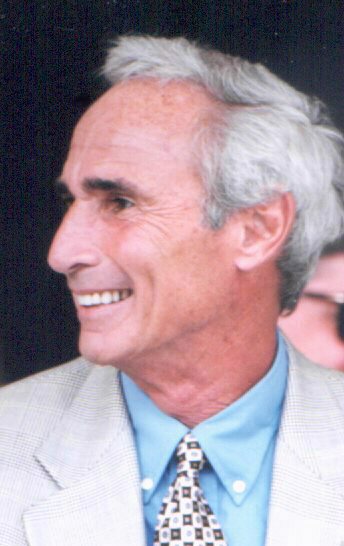
(Left) Senator Bill Frist, unable to hide his concern after learning of his wife's "wasted time" lawsuit.


Her announcement came just hours after Frist announced he would not be seeking the Republican nomination for president in 2008.

"Everyone knows why I wrote that dumb book," said McLaughlin, who authored and has recently been doing press tours for "Love You, Daddy Boy": Daughters Honor the Fathers They Love." I only wrote it because Bill wanted to get his Frist name out there in plenty of time for Iowa and New Hampshire and all that primary B.S. So like a good little wife I did what he wanted - I wasted a lot of time on things like research and ghostwriters - and then he pulls he pulls this crap on me. Well, I'm not going to let him get away with it. I may not be a big-shot politician or famous heart surgeon like he is, but my time is worth something, too."

Senator Frist refused to comment on his wife’s lawsuit, referring all questions to his office manager, who was on vacation until after the first of the year.

The amount of damages being sought by McLaughlin on the basis of her wasted time has not been made public. But indications are that it may become a class-action suit, with other literary wives such as Elizabeth (Mrs. John) Edwards, another recent first-time author, becoming involved should their political husbands also fail to pursue their well-known presidential ambitions.

“It’s really uncharted territory,” said D.C. lawyer and literary agent Benjamin “Briefcase” Torte, who has collaborated on several hastily-written candidate “books” over the years. “Given that large corporations have been leveraging their brand names for years, I suppose we shouldn’t be surprised to see in happening with political families as well. But if she’s claiming breach of promise, this kind of suit could have far-reaching implications. It could cause young people thinking about entering the political field to include agreements about situations like this in their prenups.”

"I understand how people may think this looks ridiculous, going to court and all," said McLaughlin at a hastily arranged press conference. "But if it gets me out of having to spend a full hour with Larry King, that in itself will be worth it."

Tuesday, November 28, 2006

A Recent Thought About Church Music

By Hadleyblogger Bobby

While my voice teacher was between students and visited friends, the student who precedes me (who is 21 or more years older than I am) and I discussed the trends in church music, and she grew concerned after the new music leader in her church is pushing the pop. She thought it was the denomination, but as I learned in a visit to a church to the south of my home in the Midlands of South Carolina, that is not the problem.

"It's not the (major denominations) behind the push towards pop-rock music. Rather, it is the influence of younger music leaders, their attachment to pop-rock music, and the payoffs of the major church music publishers, especially since most of the major (to Protestant) publishers are secular giants (Britain's EMI Group plc, Germany's Bertelsmann AG -- whose music publishing arm is slated to be sold to France's Vivendi, and Warner Music Group, led by Edgar Bronfman, Jr, the heirs to the family which ran Seagram's liquor). For Catholics, the major offenders are GIA Publications (Chicago) and Oregon Catholic Press. In most cases, however, it is the idea of younger music leaders who have never heard Bach, Handel, or Haydn, pushing their congregations into dumbing down the music.

Today's church music leaders who are in favour of the pop-rock are well-supported with the powerful marketing forces of EMI, Bertelsmann, WMG, GIA, or OCP, which are well financed, and with the more Protestant-based publishers, the huge marketing machine of the three which are supported by cash and support to encourage playing their songs, since church will have to pay the publishers to play their songs, and add their influence everywhere.

EMI, the largest publisher, pushes church leaders to play the latest Chris Tomlin rock piece, which is backed by their huge departments, including sales of Tomlin's latest album at major retailers such as Wal-Mart, Target, Sears Holding (Sears Gold and Kmart), Best Buy, Sam Goody, and also the same of downloads of Mr. Tomlin's music at sites endorsed by EMI. The major pop-rock supporters release "Worship Together" albums and magazines to tell church leaders how to play the latest rock song via chords (no sheet music) and give no respect to those by the sheet singers.

The leaders then push for choirs to sing karaoke to modern rock soundtracks.

On the night as I walked back from our Precept study, I watched as kids practiced their Christmas musical. It was downright disgusting and my teacher would have blown the whistle for poor vocal quality on the students. The voices were amplified and they used karaoke accompaniment.

The issue is further detailed in an article from seven years ago, "The Triumph of the Praise Songs," written by college professor Michael Hamilton.

But in all of the research, it is clear that the push for more "contemporary" rock songs in church is not by a denomination; rather, it is the worship leaders, who have been influenced by the rock songs from attending conferences provided by the major record labels, behind the betrayal of the hymnal, the oratorio, and aria. One year, my voice teacher (not my present voice teacher) and I were awaiting the start of a lesson (it was at an Episcopal church's choir room, as she was a member of the church), and one of the rock artists was practicing the "modern worship" tunes for a future service for teens.

The kids are influenced by the modern work; in churches, modern rock services outdraw organs, two to one. I ask if the MTV generation, fresh off winning an election with MTV influence (through The Daily Show and the Colbert Report), also is winning the worship music war with MTV-style pop/rock in churches, pushed by the major publishers because the more they play the pop-rock songs, the better it puts the bottom line of the publishers, especially the bottom line of the companies which produce such publications.

Leadership trained by MTV has created the vacuum which is hurting those in church who wish to sing the majestic works of the great composers.

Wednesday, November 22, 2006

The War on the "Investor Class"

By Hadleyblogger Bobby

In the runup to the election, I wrote Charleston radio talk show host Charlie Thompson an interesting perspective, and what I believe is the next big battle in the New Left Congress -- The War on the Investor Class.

From a standpoint of time, today's stock market is like the Biblical parable of talents. Help support good companies, and you will see your money grow. Lazy people with money will not work or see that talent grow.

On the Web site OPENSECRETS.ORG, I found a report on investments, and my belief is when liberals talk about "two Americas" (as John Edwards says) orbring up their "class warfare" redistribution tactics, their fight isn'tabout Upper vs Middle vs Lower Class, but instead Investor Class vs the Non-Investors.

One example of a tax the New Left wants to impose is to tax capital gains not as a lower rate (15% -- Bush wants it even lower!) but instead tax them as income, which in their dream world, is 40%. (There are plans established by liberals to raise the income tax rate to 40% for certain people.) Liberals imposed a "sunset" on Bush tax cuts so that the Bush Tax Cuts will be killed immediately so their tax hikes will go back into power.

The Left hates investors because investors would rather put a dollar after leisure (golf, theatre, opera, the SC Philharmonic, hockey games -- yes, AA-level hockey is very popular in South Carolina, with two current ECHL teams (the Charleston team draws 10,000 for the Interstate 26 War between teams in Charleston (Washington affiliate) and Columbia (Toronto affiliate)game) and a third (Conway) starting in 2007-08, and the works; the Wild's AA affiliate is in Beaumont, TX.) into the market instead of putting the same dollar into Powerball. The state LOOTtery collects over one billion dollars a year in revenue -- if it was a publicly traded company, it would make more in revenue than all but the state's top five publicly traded companies, two of which (SON and SCG) I hold shares. Liberals believe money in their pocket is better than money in my pocket. A look at the Opensecrets.org report on Congressional investors will show where conservatives are more likely to go into the market than liberals based on the top fifty companies (and ties).

The Opensecrets.org report on Congressional Investors (Firm - Total Investors - Dems - Reps)

1. General Electric - 103 - 37 - 66
2. Pfizer - 80 - 32 - 47
3. Cisco Systems - 75 - 30 - 45
4. Microsoft Corp - 73 - 24 - 49
5. Intel - 67 - 26 - 41
6. Exxon Mobil* - 64 - 18 - 46
7. Johnson & Johnson - 54 - 22 - 32
8. Home Depot - 53 - 21 - 32
8. Procter & Gamble - 53 - 21 - 32
10. JPMorgan Chase - 50 - 17 - 33
11. IBM - 49 - 17 - 32
12. Citigroup - 46 - 15 - 31
13. Wal-Mart - 43 - 12 - 31
14. Verizon - 42 - 10 - 32
14. Coca-Cola Company* - 42 - 11 - 31
16. AT&T Inc (1) - 41 - 12 - 29
16. Merck - 41 - 14 - 27
18. Amgen Inc - 40 - 10 - 30
19. PepsiCo - 39 - 14 - 25
20. Hewlett-Packard - 38 - 15 - 23
20. Dell - 38 - 14 - 24
22. Time Warner - 37 - 17 - 20
23. Lucent Technologies (2) - 34 - 12 - 22
24. Chevron - 32 - 10 - 22
24. Walt Disney Co - 32 - 11 - 21
26. Wells Fargo - 31 - 12 - 19
26. Nokia* - 31 - 13 - 18
26. Medtronic - 31 - 10 - 21
26. Motorola - 31 - 9 - 22
26. Comcast - 31 - 10 - 21
26. British Petroleum - 31 - 8 - 23
26. Bristol-Myers Squibb - 31 - 11 - 20
33. Wachovia** - 30 - 9 - 21
34. Texas Instruments - 27 - 14 - 13
34. American International Group - 27 - 12 - 15
36. Fannie Mae - 26 - 9 - 17
36. Oracle - 26 - 8 - 18
38. Altria Group (3) - 25 - 5 - 20
39. American Express - 24 - 6 - 18
39. EMC - 24 - 9 - 15
41. Bank of America - 23 - 7 - 16
41. Washington Mutual - 23 - 11 - 12
43. Vodafone (4) - 22 - 12 - 10
43. Sun Microsystems - 22 - 12 - 10
43. Tyco International - 22 - 6 - 15 - 1 Independent
43. ConocoPhillips - 22 - 7 - 15
47. Berkshire Hathaway - 21 - 7 - 14
47. Ford Motor Co - 21 - 7 - 14
47. Walgreens - 21 - 11 - 10
47. MedCo Health Solutions - 21 - 10 - 11

* Bobby holds shares in these companies.

** Bobby has his brokerage account in Wachovia Securities. Bobby also has an IRA with Sharebuilder, a joint venture of various financial firms, and in some firms has a DRIP account, administered by the Bank of New York, Citigroup, or Computershare.

(1) The former SBC Communications. Includes investments in the former American Telephone & Telegraph, which was purchased by SBC. SBC changed its name to AT&T after the takeover.

(2) To be acquired by France's Alcatel.

(3) The former Philip Morris. MO is also a minority interest holder in South African Breweries (Miller beer) and Kraft Foods.

(4) Vodafone is the world's largest wireless telephone company, based in the United Kingdom. Verizon Wireless is a joint venture of Verizon andVodafone, and is their only way to penetrate the US market.

This report should show where the Right puts their money where their mouth is - in the investment bank, and to prove they are the Party of the Investor Class.

I noticed how the Democrats are huge into Vodafone, the big European phonegiant. Why aren't we seeing many liberals investing into American phonegiants? I also saw how the Left dislikes (gasp!) investment brokerages.

One attack on the investor class I am hearing from the liberals: They are planning to remove tax breaks currently in place to encourage drilling in the United States, as part of an attempt to force us to buy our oil from their cronies in Venezuela (Hugo Chávez) or in Iran.

The Investor Class was built by changes which created discount brokerages, the Dividend Reinvestment Programs (DRIP), the influence of CNN's Moneyline (from 1980-2001, CNN's financial news show) and CNBC (including "MadMoney," the show designed for the 18-34 crowd), and the Bull Market. The Left's attack on the Investor Class is a want to return to the era where government money was better than the free market, and that's why they do not want Social Security invested in the market, when clearly the market has created a Bull Run that has given us President Bush, an investor himself.

This Just In

By Steve

“Palance Virus” Seen as Possible Biological Weapons Breakthrough

ATLANTA, GA – Scientists at the Centers for Disease Control are attempting to isolate the virus that recently claimed the life of veteran film tough guy Jack Palance, who passed away earlier this month at age 87. Unnamed sources confirm that the effort has been initiated by the CIA for possible use in a secret biomedical weapons program.


(Left) Movie tough guy Jack Palance: Is it possible he's even tougher in death than he was in life?


“Anything that could bring Palance down has got to be one nasty bug,” said the source. “I mean this guy defined craggy. Not only did he play probably the meanest sonofabitch in movie history, he was also out there doing one-arm pushups at the Oscars on national TV in his 70s. He was like a like a walking piece of beef jerky.”

If the so-called “Palance Virus” can be isolated, military analysts are speculating about its possible use in combat situations.

“This is no little scratchy throat, low-grade fever, stuffy head, 24-hour infection,” said retired General Remington S. Gatling, former director of the Army’s secret Biological Weapons Division. “We’re talking weapons-grade. It has to be.”

Once identified, the virus will be subjected to rigorous testing to determine its viability as a biological weapons agent. General Gatling described the process the virus would likely undergo. “First, benchmark standards will be created, by which the relative strength of the virus can be measured. Our scientists will then construct computer models based on DNA samples of certain well-known individuals and, by introducing the virus, simulate the effect it would have on these individuals, telling us about its potency as a biological weapon."

Referring to a copy of an intricate, brightly-colored PowerPoint bar chart, Gatling elaborated. “For example, at the lowest end of the scale we have C-list comedian Andy Dick. This would be the absolute minimum strength required for the virus to be effective – at this level you might as well be talking about the common cold.” Moving further up the scale, Gatling noted that the standards become more demanding. “Arnold Schwarzenegger, who's aging but still pretty buff. Then there's legendary fitness guru Jack LaLanne - you could simulate the effect of it being introduced into one of his juice drink concoctions. If he went down, that would be a good sign. Right after him, Art Linkletter, who first appeared on television three years before it was invented. Some suggested Tony Bennett would be a great test case, but others recommended former President Gerald Ford. They'll probably run it through all those models and sit back and see what happens. You’d need a pretty damn potent bug to bring down any one of them.”

The top of the scale represented the Army’s biggest obstacle, Gatling conceded. “Without a doubt, our biggest challenge is Keith Richards.” The famed Rolling Stone rocker “has probably pumped more chemicals into his body than any human can imagine, to no discernible effect. We’re not sure, but it’s possible he may have built up immunity to any conceivable biological attack. If the Palance Virus could bring him down, we'd know we really had something.

Meanwhile, funeral services are pending for Palance awaiting complete confirmation of his death.

Tuesday, November 21, 2006

If He Said It

By Mitchell

So Fox has pulled the plug on the O.J. interview. But thanks to the miracles of modern technology, let's find out what O.J. was really up to...

Wednesday, November 8, 2006

Why Bush Should Resign

By Mitchell

Bet that headline got your attention, right? (Either that, or the shock of me posting twice in two weeks.) Of course it’s an attention-grabber as well as being something utterly unlikely to happen, but as an academic exercise it provides a little fun. And while I’m deliberately being provocative, I want to make some serious points as well.

First of all, in the interests of full disclosure I should mention that I've never considered myself a Bush supporter. I didn't vote for him in 2000 (don't worry, I didn't vote for Gore either), and only voted for him in 2004 with reservations. And I do consider myself a former Republican, as well as a former politico. I’m one of those conservatives who feels deserted by the Republicans over the last few years, and I’ve also come to see the folly of depending on politics to answer life’s burning questions (at least politics unsupported by faith). But having said that…

Throughout the Bush administration, but most especially in the nomination of Harriet Miers to the Supreme Court, we have seen the party hierarchy acting as an adjunct of the administration itself. When the RNC campaigned in behalf of Miers (or, more precisely, Bush’s nomination of Miers) it was saying, in effect, that what was good for Bush was good for the party. Not just good, but essential. Taken in conjunction with the typical party line – Republican policies are better for the country than those of the Democrats – one can assume the logical continuation of this thought, which is that Bush’s agenda is good for the country.

Looking at Bush not only as president but as leader of his party it is (to me) an inescapable fact that he is no longer capable of providing leadership on the issues most important to the party’s national agenda. In state after state we saw many incumbents losing because of their relationship to Bush, i.e. being in the same party with him. Not withstanding the loss of the abortion law in South Dakota and the ESCR amendment in Missouri , many of the referenda up for votes last night – same-sex marriage in several states, the MCRI in Michigan , the popular vote on the death penalty in Wisconsin – provide confirmation of Republican core issues. Issues that many Republican candidates failed to connect with, at least until it was too late.

This is not to mention the several cases where the national party organization viciously opposed conservative Republicans involved in primary contests with liberal Republican incumbents (Rhode Island this year, Pennsylvania two years ago). Nor can we neglect the abuse that conservative Republicans have taken from the party organization when they opposed Bush’s policies – on immigration, for example. (Rumors swirled last night and this morning that he would try to work out a deal with House Democrats for a more liberal policy on immigration.)

One wonders where the party goes from here. Are Bush’s policies still the gold standard for the Republicans, or is it every man for himself? If Bush can no longer function as leader of the Republican party, the party that is now committed to providing the loyal opposition, what happens to the Republican agenda?

If we equate the president in his role as party leader with that of national leader, and if we conclude that Bush can no longer credibly lead the party (remember, this is only an academic discussion – a man with nothing to lose may yet surprise us in his final two years), it then follows that Bush can no longer adequately function as president. He cannot manage his party’s agenda, whether through Congress or to the American people, and if that’s a significant part of his role as president then he is failing the test.

Logically then, he should resign.

There are a number of reasons why this won’t happen. We’re not a parliamentary government after all, where the leaders are periodically subject to votes of no confidence. (You have to wonder how many presidents we would have gone through in the last fifteen years or so if that option had been available). Furthermore, on a more purely practical political level, if Bush resigns we get Cheney. In addressing Bush’s shortcomings, would we really be any better off? Cheney is at least as closely identified with the Iraq fiasco as is Bush; to the extent that Iraq cripples the administration, Cheney is at best a push. And while Cheney may well lean more to the right on other issues than Bush, it’s doubtful that he’d have the popular support to get a more conservative agenda through. Besides, he’s not a candidate for president in 2008; allowing him to run as an incumbent through resignation (as Clinton should have done with Gore during Bill’s impeachment) isn’t a factor.

So what then? Bush and Cheney ran as a team; do they step down as one? Leaving the president pro-tempore as the new chief executive? And who is it, anyway? What’s that? Ted Stevens? Uh, never mind. Don’t even suggest the next in line, Speaker of the House Dennis Hastert. And as a reasonable Democratic friend mentioned to me, there’s no telling what kind of havoc this kind of turmoil would wreak on the economy.

Given the circumstances, this is a scenario that just ain’t gonna happen, except in political potboilers. And yet, my suggestion is only slightly on the facetious side. The president has been a disaster – his foreign policy, while well-intentioned, has lacked vision and failed to correctly anticipate what would come next. One can hardly doubt that Bush recognizes the importance of the war on terror – he knows this perhaps as well as anyone and certainly better than most in the Democratic party. But he no longer has the credibility to carry this fight to our enemies. Domestically, Bush has betrayed the fundamental principles of the conservative, i.e. Reagan, revolution. Certainly in this he has had company, for much of the Republican Congressional leadership has joined him in jumping over the edge. But were they simply playing follow the leader? Was the makeup of Republican leadership inevitable given the disposition of the man at the top of the ticket?

The bottom line is this: the president should either lead, follow, or get out of the way. Bush has demonstrated that he cannot lead, and as president he certainly should not follow the lead of the Democrats. That leaves only one option.

Tuesday, November 7, 2006

What the Left Means in "New Directions"

By Bobby

Liberals are losing the momentum despite their "new directions" strategy. With the big conservative momentum and slingshot, is this slingshot of the Saddam conviction, good economic numbers, and huge push enough to put us over the top and keep Dennis Hastert & Company in control of the tax policies, and us in control of the judiciary?

Think of the Left's "New Direction" which will kill investors and the market:

  • New Direction: More judges who will overthrow the US Constitution and replace it with unratified treaties from the United Nations and adopt European law to overturn our Constitution.
  • New Direction: Same-sex "marriage" legalised.
  • New Direction: Secular humanism as the Official State Religion. There will be some alternative religions allowed, but anything based on Christianity will be banned.
  • New Direction: Banning of conservative talk radio from airwaves by speech codes. ("Fairness Doctrine") The codes would also ban religious speech on airwaves.
  • New Direction: Homosexual Special Protections to protect child molesters, banning of laws to protect children.
  • New Direction: Higher taxes and the elimination of the Investor Class by punishing investors with higher taxes, including the elimination of the Extended Term Capital Gains Tax Rate.
  • New Direction: Books revised to promote a Communist angle.
  • New Direction: Congress is meaningless because of the judicial activists in court who will write our laws.
  • New Direction: Terrorists to win control of Iraq, and Iran takes over.
  • New Direction: We lose all wars and we retreat everywhere. Military will be weakened to a "peace" making Peace Corps or AmeriCorps.
  • New Direction: Taiwan to be pigeonholed.
  • New Direction: Ban on research, except for those which will kill people. The research ban will include elimination of tax breaks for major firms to perform huge research on new sources of energy, oil, and a way to turn ANWR into a "monument" so that terrorists and dictators will control oil fields, and we can't be reliant on our own energy.
  • New Direction: The opportunity of new inventions will be gone thanks to liberals' attack on the American Corporation.
  • New Direction: Foreign takeovers in business, research, and our laws.

Monday, November 6, 2006

This Just In

By Steve

Fortune Cookie Writer Fired, Claims Bias

KING OF PRUSSIA, PA -- Local resident Harold Ludman says he can’t understand why he was recently fired from his job writing fortunes for the homemade fortune cookies served at Leonard Wang’s Chow Palace.

“My fortunes speak to the human condition,” Jones said, holding a sheet of paper with his most recent saying, "When misery knocks at the door, you don’t ask if it’s made a reservation." I know it’s not cheery, but it’s real life. People need to face up to that once in awhile.”

Other fortunes which Jones said he was proud of included “If at first you don’t succeed, try again, but know that the possibility is great that you might fail again,” and “Every glorious sunset means you’re one day closer to the cold eternal darkness of the grave.”

Jones said he had always hoped to find a profitable use for his Master’s degree in the works of French existentialists such as Camus and Sarte, and considered writing fortune-cookie fortunes to be the ideal job.

Wang, however, begged to differ.

“People look for escapism when they crack open a fortune cookie,” he said. “They want to read things like, ‘You will meet a tall, dark stranger,’ not the depressing crap he was coming up with. I was afraid I was going to have to start offering Prozac instead of after-dinner mints.”

Ludman, who himself had recently undergone electro-convulsive therapy at nearby Pleasant Valley Mental Health Clinic and Sanitarium, was disappointed with Wang’s decision, but sought to put a positive spin on the dismissal. “I was thinking about getting out of the fortune-cookie business anyway,” he said. “To be honest, there isn’t a lot of growth potential in it. I didn’t want to be caught in the bathroom when the last lifeboat leaves the Titanic, if you know what I mean. Hell, I’m not sure I know what that means.”

As for his future plans, Ludman said, “I’ve already sent my resume to Hallmark. There’s always a market for a good greeting card.”

Friday, November 3, 2006

This Hoffmann a Tale Worth Telling

By Mitchell

Jacques Offenbach died before completing Les contes d’Hoffman (The Tales of Hoffman), which makes it something of a challenge, to say the least, in figuring out exactly how the opera should be done. As is usually the case when dealing with unfinished compositions, a raft of composers, producers, directors, and musicologists have since had a go at what they thought Offenbach would have wanted, and the results (in whatever version) have been good enough to earn Hoffman a much-loved place in the opera repertoire.

But the multiple versions (one critic called it a perpetual work-in-progress) also give producers and directors a great amount of leeway in deciding how they’re going to stage the work. And given the direction the Minnesota Opera has taken during its history, one had good reason to be apprehensive when approaching this year’s production. Ultimately, these apprehensions were mostly groundless in the season’s fourth performance of Hoffman Thursday night at the Ordway.

There was much to like about this Hoffman; the sets, for one thing. Having gotten used (resigned) to the MO’s minimalist staging of recent years, the comparatively lavish sets (which came from the Seattle Opera’s 2005 production) were a delightful surprise. The appearance of the Venetian canals at the start of Act Three produced an audible gasp in the audience, and there were other expressions of pleasure throughout the performance.

The singers were pretty good, too. Richard Troxell, in the title role of the drunken poet, displayed a certain degenerate charm that makes Hoffman an appealing anti-hero. Even though much of his misery is self-inflicted, you can’t help rooting for him even while you’re castigating his decisions. Troxell combined a pleasing vocal style with a physicality that made the role, well, sing. Since Hoffman is in virtually every scene (with the exception, oddly enough, of Act Two, which often is the most affecting) the role requires someone up to the task. Troxell fit the bill.

As Hoffman’s Muse, who masquerades as his friend Nicklausse throughout most of the opera, Adriana Zabala provides a most adequate sidekick. The Muse is a jealous lover who wants Hoffman for herself (the artist dedicated to his art), yet her desire to protect him from the situations into which he constantly gets himself seems born of a genuine concern and love at least as much as jealousy. Zabala’s Nicklausse displays a good-humored exasperation with Hoffman, but it is always discreet, never overbearing. She won the lion’s share of the applause at the curtain, for good reason.

Dean Peterson was poised to steal the whole thing in the showy role of the four villains – Lindorf, Dr. Miracle, Coppelius and Dapertutto – who torment Hoffman throughout the opera. These roles are generally played by the same bass in the same way that Hoffman’s loves are often played by the same soprano, but more on that later. With shaved head and dark glasses, Peterson evoked a sinister, Lex Luthor-like aura that was extremely effective. Why didn’t he get more applause at the end? I don’t know – perhaps, because of his costume changes, not everyone realized it was the same actor throughout?

And there were other good things, too – the dancing wine bottles of the prologue, the use of marionettes in Act Three to demonstrate Peterson’s Dapertutto as the puppet-master manipulating poor Hoffman, and the singers in many of the supporting roles, just to name a few. But of course, being the Minnesota Opera, there were going to be some things that didn’t work quite as well. And while they weren’t fatal to the production, they couldn’t be ignored either.

First of all, there’s the casting of Hoffman’s leading ladies. In his pre-concert talk, Artistic Director Dale Johnson noted that this production (unlike the MO’s previous production of Hoffman ten years ago) had opted not to follow the occasional practice of casting a single soprano in the roles of Hoffman’s three lost loves – Olympia, Antonia, and Giulietta – as well as his current love, Stella. And I’m not sure this was the right decision. As Wikipedia notes, “[i]t is important that the four soprano roles be played by the same singer, for Olympia, Giulietta and Antonia, are three facets of Stella, Hoffmann's unreachable love.”

Johnson’s rationale for the casting was to emphasis the “distinct personalities” of each of the women. I suppose this could be a defensible decision, but it’s just as likely that the MO, continuing to pour money into needless commissions for unnecessary operas such as the upcoming Grapes of Wrath, probably couldn’t afford the big bucks needed to get a soprano who could handle such a wide-ranging role.

This isn’t necessarily a knock on the singers portraying the women in the current production. True, Alison Bates’ Giulietta was the weakest of the lot – her voice had difficulty projecting to the upper reaches of the Ordway, and her acting never seemed to really convey the courtesan’s personality – but then, Giulietta is the least fleshed-out of Hoffman’s loves in the first place, being almost entirely created after Offenbach’s death. And the MO’s abruptly brief version of the already-short Act Three didn’t give us much of a chance to get to know her anyway.

As for the others, Nili Riemer was exceedingly charming as Olympia, the robot with whom Hoffman falls in love in the first act, and Karin Wolverton affectingly winsome as the doomed Antonia, Hoffman’s second act love. We don’t get to see much of Lisa Butcher’s Stella, the current object of Hoffman’s affections, who appears only in the prologue and epilogue.

But let’s return for a moment to the question of one soprano playing all four roles, which has been done in the past to great effect, notably by Joan Sutherland and Beverly Sills. Now, it’s true that this type of casting can result in the soprano role overshadowing that of Hoffman himself. I’m not sure if Offenbach himself intended for the casting to be thus, but in an opera that can struggle at times with narrative cohesion, having such a dominant presence can’t hurt.

Which leads me to my second misgiving about Hoffman, that sense of a certain something that was missing. And it is this: a sense of warmth, of pathos. The tale of Hoffman is, at heart, a bittersweet one. For all the uproarious comedy of Act One, for all of Hoffman’s drunken charm, there’s no denying that losing your three great loves in life – no matter how real or imaginary the love might have been – is a heck of a bad thing to have happen to you. And despite the Muse’s promise that Hoffman’s true fulfillment in life will come not from love but from art (and we all know how vital suffering is to the production of great art), the opera still seems to demand a certain level of melancholy. The prologue and epilogue bookend an epic type of story, a man’s journey through a life of love and loss. John Paul II often spoke of the “drama” of ordinary life, and Hoffman’s life provides that kind of drama in spades. Only it didn’t quite come through in this production.

Perhaps the editorial decisions made in assembling this version had something to do with it. Johnson explained that based on amount of material available, the opera could have run five hours; as it was, it ran three-and-a-quarter. And although Act Three has always been the most problematic, it still seemed to end rather suddenly, leaving Hoffman’s third lost love as little more than a footnote. (And a live one at that, unlike many of the versions that provide her with an accidental death.)

Maybe it had something to do with the broad farce of Act One, the absurdity of falling in love with a doll (unless you’re talking about Julie Newmar) obscuring the sense of loss which Hoffman nonetheless felt upon learning the truth. Act One’s comedy combined with Act Three’s brevity serve to isolate the tragedy of Act Two, the only one in which Hoffman’s loss has a truly emotional impact on the audience (which might be one reason why this act has frequently been staged as Act Three, with its dramatic musical climax providing the perfect lead to the epilogue.)

Or it could be the lack of a sense of time passing, of an older Hoffman looking back on a life lived long, if not always well, ala Cyrano.

Whatever the reason, it was clear that something was lacking, somewhere. After sitting through a three-hour-plus drama, the listener’s pleasure should be combined with a sense of coming to the end of a long journey, a shared experience that leaves everyone emotionally drained. And despite the enthusiastic response of the audience as the final curtain fell, I didn’t sense that feeling in the applause which greeted the singers at the curtain call. It was appreciative, but not overwhelming.

Jacques Lacombe, making his Minnesota Opera debut in the pit, did a nice job with Offenbach’s beautiful melodies, although there were times when the orchestra threatened to overwhelm some of the singer’s quieter moments, as in the Barcarolle at the start of the third act. The Barcarolle should be noted as a singular disappointment; it’s probably the most famous piece of music from Hoffman, the one with which the public at large is most familiar. It features a duet between Giulietta and Nicklausse, cast against the backdrop of the gondoliers piloting their boats through the canals of Venice, with the chorus joining in. It was a beautiful scene as staged on Thursday, except you couldn’t really hear any of the singers. And while it should be added that it’s always difficult to tell whether this is the fault of the orchestra or the Ordway’s miserable acoustics (maybe we need to rethink our opposition to mics on the singers after all), it remains true that anyone attending Hoffman looking forward to the express purpose of reveling in the Barcarolle would have been let down. And the feature piece of any opera shouldn’t make you feel that way.

In the long run, while these shortcomings do qualify as more than just quibbles, they ultimately failed to overshadow a production that might have been better in parts but seldom failed to charm or excite. It was far from the worst the Minnesota Opera has to offer. And, given the MO’s track record over the last few years, that’s reason enough for at least two-and-a-half cheers.

Thursday, November 2, 2006

Anyone for Tennyson?

By Judith

The title of this piece was the title of a show on PBS many years ago in which four actors would recite poetry. I can see you all jumping up and down now. However, if any of you remember being read to as a child, you might recall the excitement and thrill of the words on the page leaping out and nestling into your ears. The story was alive in a way that went beyond the imagination you use when you read silently.

At about the same time there was a radio show called "Reading Aloud." At a point in my life when nothing much else would pique my interest, listening to the books - entire books over the course of a few weeks - being read gave me something to look forward to. It brought a familiar comfort, like when my mother would read to my brother and me every night before we went to sleep. (Being naughty brought a punishment of no reading. Yikes!)

Poetry and prose were recited as a form of entertainment and communication back in the days before radio and television. It was not uncommon for children to memorize poems or Psalms and perform them for family gatherings. Books-on-tape aside, we've all but forgotten that our language was meant to be heard as well as seen. (Txt msg any 1?)

The trick, of course, is to say it in a way that is pleasing. That's why the program "Anyone for Tennyson?" was so good. People who made their livings interpreting writers' words out loud were the ones reciting the poetry. In Poems for Enjoyment, editor Elias Lieberman writes an introduction for each of the sections of poems he has selected. The section "The Music of Poetry: Rhythm" starts off like this: "Not all people recognize rhythm in poetry. Some are rhythm-deaf, just as other are tone-deaf. If you have ever heard a song rendered by a person who cannot carry a tune you have some idea of what any poem, no matter how good, must mean to one whose sense of rhythm is tragically paralyzed. Such persons should not attempt to read poetry aloud." (Somebody ought to tell that to Garrison Keilior.)

Two poems in this section of the book, "The Santa Fe Trail" by Vachel Lindsay and "The Conjurer" by Lew Sarett even have director's notes in the margins next to the stanzas, with comments like, "To be read or sung well-nigh in a whisper" or "To be chanted." Clearly, the poets expected their poems to be read out loud.

But today if you attend a poetry reading, you're just as likely to hear prose... broken up... in lines... that may look... like a poem. But isn't... Rhyming isn't an absolute necessity, but there is a musicality and rhythm about poetry that separates it from prose. (Although good prose can be poetic.)

My point, and I do have one, is that good poetry shouldn't be left languishing on a dusty library shelf. Wouldn't it be something if actors, or anyone with the talent for rhythm and expression, were to recite good poems in public. Wouldn't it be something to hear a Shakespeare or Browning sonnet or a lyric by Wordsworth, Tennyson, Frost or Poe come to life on the stage or the radio or the television. Wish I had that talent. I'd take it on tour.

Monday, October 30, 2006

Bobby's Reflections

By Bobby

I looked at an old column of Mitchell's last week and reflected on the following comments about the state of opera in America, or at least up there in Minnesota :

"Or take Menotti's The Consul, the story of a woman trying to get a passport to escape a totalitarian country. This would seem right up the alley for a company that likes 'message' operas. (And, in fact, the MO [Minnesota Opera] did do The Consul - back in 1979.) You might ask yourself why the MO doesn't revive it? Maybe they can't figure out a way to suggest to the audience that George W. Bush is the leader of Menotti's totalitarian state, I don't know. My point here is that to bring Menotti back (and several opera commentators have mentioned that the time is ripe for a revival of Menotti) It would show something that the MO doesn't often exhibit - creativity. They like to think they do, what with their new, provocative productions - but new doesn't equal creative."

Being someone who was very new into opera at the time (only my third opera attended, and I was 27!), I have always associated The Consul with the Facists or Nazis of World War II. It seemed that was how I saw it because of the time it was written, having a history degree from college.

Unfortunately, in a strange way, what happened has been drilled deep in my brain. A few months later, after my alma mater was trashed in a football game against its rival, I said I was seriously considering suicide, and the next morning at church, I collapsed in the same way as Magda did in the end of Act II, in the room while awaiting everyone else to come from their early rock service. All of it was a joke, and today, if I'm angry, I'll say I am this mad that I'm taking my own life, and then say like Magda Sorel, explaining the humourous line because of the nature of Magda.

Of course, the "punch line" is the lady who played Magda in the performance in question has always known the joke when I say it. (My voice teacher!)

As someone whose parents and grandparents escaped from China to Taiwan in the late 1940's, I can associate it with people escaping from a Communist nation. But after studying facism and the National Socialist Workers' Party of Germany in World War II, I can also associate with those nations.

(As an aside: My voice teacher called me the Monday before The Consul, saying, "Bobby, I need to postpone our (final) voice lesson (of the session). I have to do this scene." After watching Magda's suicide scene, I could understand. Just 21 months previously, she lost her mother to suicide. This was intended to be my last voice lesson with her, as she took a position after graduation in a college in Winter Park, Florida. After signing a deal with her friend for a year, I didn't know what my future vocally would be. Somehow, the homesickness for the palmetto trees erupted during appearances at an opera contest and when her graduate school professor retired, she told her closest confidants -- including myself -- that she was returning to her beloved Palmetto home. Of course, when that was announced, I inked a new deal.)

Friday, October 20, 2006

October Surprise

By Judith

This has been a November kind of October. Gray skies, blustery winds, snow showers and temps a good 12 - 15 degrees below normal. Whenever the sun does pop out, it tires quickly and soon fades away. I'm ready to start stuffing the turkey now.

We are entering that limbo-time of year between peak color and Christmas lights. The trees have few, if any leaves; the prairie grasses are tossed in the breeze, shushing everyone who passes; and the vestiges of summer blooms are dried and brown. The mums are huddled together, still putting on a bright front, knowing that they'll never make it past the next hard frost.

And then, to add insult to injury, just before Halloween, we pull the plug on daylight. Suddenly, we get up in the dark, spend most of the day indoors, and go home in the dark. Our souls cry out for light. It’s as though we experience a physical kind of Advent before we come to the spiritual one.

And what do I do? Leave a wake-up call for May.

Callas Part II

By Hadleyblogger Drew

Here's the second half of that video I promised of Callas' Covent Garden performance of Tosca. (And by the way, thanks to Terry Teachout for leading us to these clips.) This picks up where the previous clip ended. Tosca has just sung her famed aria, Vissi d'arte. Now, acquiescing to the demands of Scarpia (the great Tito Gobbi), she agrees to a night of passion in return for the relesase of her lover, Cavaradossi. However, somewhere along the line Tosca changes her mind. She picks up a letter opener and plunges it into Scarpia, killing him, before stealing the pardon for Cavaradossi and escaping into the night. Only to return to the cheers and adulation of the crowd.


Tosca was, as I recall, Callas' debut at Covent Garden, and no doubt the great anticipation has something to do with the tumultuous response of the audience. However, as I suggested earlier, there can be no doubt that this scene sizzles with drama. Callas and Gobbi are old hands at this thing, and it shows.

There is some question, at least recently, as to what was going through Tosca's mind during the early part of this scene. When the Minnesota Opera staged Tosca last year, the director cleverly [sic] had Tosca pick up the murder weapon much earlier, concealing it until the ooportunity arose. This clearly suggests a premeditation I don't think the text warrarnts. Look at the horror in Callas' reaction to what she's done - the confusion (only somewhat caused by Callas' own nearsightedness), the revulsion (my God, what have I done?), the realization that nothing's going to be the same again (you know this opera isn't going to have a happy ending). And the calculation as well - she may be horrified, but she remembers to grab the pardon from Scarpia's dead body before she leaves.

No, I don't really buy the idea of premeditation; it's just one more gimmick to try and put a unique stamp on an operal that doesn't really need anyone fiddling with it. What you see in this scene is drama from two great actors, and that's what makes it one of the great scenes in opera.

Thursday, October 19, 2006

From the Bookshelf

By Judith

Ok, so on Monday I donated 3 bags of books and videos to the Dakota County Wescott Library's semi-annual sale and today I went to the sale and came home with 1 bag. I guess you can call that progress. But it's such a good deal - $1.00 for hardcovers, .50 for paperbacks. Who can resist? And at least I didn't buy anything I had donated. (The sale continues through Sunday for those of you in the Twin Cities area who are interested in checking it out.)

I started off in the biography section and scored with autobiographies of Art Linkletter (yes, he's still alive - over 90 and probably in better shape than I'll ever be) and Peter O'Toole (who looks over 90 even though he's only in his early 70s), along with a biography of St. Thomas More (who knows how he looks since he's been dead for 500 years). Then it was on to the mystery section where I found a book of short stories by Erle Stanley Gardner, which includes the only Perry Mason short story he wrote (all the others being full-length novels).

In the general non-fiction section I found something for Mitchell - The Encyclopedia of US Spacecraft (produced in cooperation with NASA, no less). This will complement nicely the other 30 or so books and magazines he has about space exploration.

But, the best for last - a 1931 edition of Poems for Enjoyment, edited by Elias Lieberman, principal of Thomas Jefferson High School in Brooklyn, N.Y. Apparently, editing books of poetry was not an unusual thing for a high school principal to do in that era because I remember seeing other such books in a used book store in Northfield this summer. This particular volume had a life in the Curriculum Library of the University of Wisconsin - Milwaukee before it started showing up in used book sales. Imagine - a university (or a high school) where they actually taught poetry in an English literature class.

The book is divided into sections such as lyric poetry, narrative verse, sonnets and French verse forms. Also included in this gem is a section of "further reading" recommendations, in case you find a favorite and want to read a whole book of his or her verse. And finally there's a section of "Aids to Interpretation" that not only offers suggestions on what the poem might mean, but asks questions so you'll learn how to think about a poem on your own.

I love these older anthologies because they don't just choose the most popular poems, but get into the "deeper cuts." They don't dumb-down the offerings because they assume that one has been exposed to poetry in school and in life.

I hope that Poems for Enjoyment will deliver not only enjoyment, but inspiration as well.

Tuesday, October 17, 2006

Callas at Covent Garden

By Hadleyblogger Drew

Well, it doesn't seem as if anybody else is putting anything up, so here's a little Callas for you, in one of her signature roles, Tosca. These clips are from her 1964 Covent Garden performance with the incomparable Tito Gobbi as the villanous Scarpia:


It was said that Callas didn't much like the character of Floria Tosca, whom she thought of as a "weak girl." Here, as her lover Cavaradossi is being tortured by Scarpia's henchmen, she sings one of the most famous arias in opera, Vissi d'arte. "Vissi d'arte, vissi d'amore" – “I lived on art, I lived on love." In other words, it's all about poor me - what did I do in life to deserve this? Forget Cavaradossi - what about me?

(This isn't entirely fair, of course - Scarpia's blackmailing Tosca, claiming that he'll release Cavaradossi in return for one night of passion. I'd probably be inclined to wonder what I did to deserve this, myself.) Tosca goes on to kill Scarpia (in a clip I'll put up later on), and after a desperate attempt to save Cavaradossi's life fails, she commits suicide in despair. I trust I haven't ruined the ending for you.

Reading the YouTube comments on this is almost laughable. Everyone has an opinion on Callas (some of them quite insightful, actually), and a venomous attitude toward anyone who disagrees with that opinion (which doesn't really add much insight at all). What a lot of people forget is that opera is theater, not just music, and theater isn't always about the finest technical performance. It's about the experience. As for me, I don't pretend to be an expert, but I know what I like. Callas may be past her singing peak at this point but she can still bring it, and the drama of this scene with her old partner Gobbi - the experience, if you will - is thrilling.

I've heard the arguments about opera being dull, preposterous, difficult to follow, you name it. There's a lot to those arguments. But I'll defy you to feel that way after seeing Callas' anguish in this performance.

Friday, October 6, 2006

The Role of Hate

By Mitchell

One of the more interesting issues raised by the Amish killings this week is the proper role of anger (or, more precisely, hatred) when reacting to this horror, as illustrated in a fascinating exchange in NRO's The Corner. Unfortunately, I think this is something that raises more questions than answers, so don't expect much in the way of definitive conclusions from me.

It actually begins outside The Corner, with Rod Dreher's post about the now-famous grandfather of one of the victims, urging others "not to hate" the killer. Dreher describes himself as one who is not at the level of forgiveness exhibited by the grandfather but, "Please God, make me into the sort of man who could."

NRO's John Podhoretz picks up on this and starts the discussion. Podhoretz is a self-described "moderately observant Jew," which I note not as some kind of neocon jag (this isn't The Wanderer or New Oxford Review, after all) but as a background to the moral footing from which he comes. Podhoretz notes that while

I can certainly see the beauty and the moral seriousness that would follow from attempting to hew as closely as possible to Christ's example of unconditional love and forgiveness. All the same, this story disturbs me deeply — because there can be no question that anger can be as righteous as forgiveness. I'm not sure I would want to be someone who succeeded in rising above hatred of those who murder children.

I suspect this is a comment that most of us can identify with. Like Dreher, we fall short of such an elevated level of forgiveness, and like Podhoretz we share a concern as to whether we really should aspire to that level. So, agree with Podhoretz or not, we know where he's coming from.

John Derbyshire next chimes in on the discussion:

Back in the Bronze Age, when folk knew what was what, Hate—personified as the goddess Eris (after whom we have just named a new Solar System object)—played a key role in civilizational survival. . . Christian meekness certainly has its place in human affairs. So does Homeric ferocity.

As Derb elicidates in a further post, he does not mean to suggest that we should emulate everything from the Bronze Age (female slavery, for example). But, he adds, "I do believe it is foolish to attempt to deny essential human nature, of which the propensity to hate those who wrong us is an invariant component, today just as much as in the Bronze Age." And he concludes, in what I think is the most relevant sentence in the discussion,

A civilization that can't summon up some pretty widespread hatred for a man who lines up little girs and shoots them in their heads, after having been foiled in an attempt to molest them, is a civilization with a spring broken somewhere.

No question that hatred has been around for a long time, and is an essential part of human nature. But did Christ come to us to transcend those motivations which drove us in the past, and in the process to transform us from our baser human nature to a higher level of understanding and love? You could get a headache just thinking it over.

Some of Derb's loyal readers did think it over, and came up with more compelling thoughts. One, citing Piper's The Four Cardinal Virtues, offers this analysis:

You will find, under 'Temperance,' a discussion of The Power Of Wrath. It focuses on, among other things, a question that Aquinas asks in De Malo (On Evil) 'whether all wrath is evil?' Later on, Pieper continues: 'Lack of sensuality is not chastity; and incapacity for wrath has nothing to do with gentleness. Such incapacity not only is not a virtue, but, as St Thomas says, a fault: peccatum and vitium. ... Only the combination of the intemperateness of lustfulness with the lazy inertia incapable of generating anger is the sign of complete and virtually hopeless degeneration. It appears whenever a caste, a people, or a whole civilization is ripe for its decline and
fall."

Podhoretz returns to the discussion with a link to a thoughtful story from First Things by Rabbi Meir Soloveichik, on the different ways in which Christians and Jews view the role of hatred. Soloveichik, in recounting the story of Saul's hesitation in killing Agag, looks at the mischief performed by Agag, and sees in it a lesson similar to that noted by Derb's correspondent:

The message is that hate allows us to keep our guard up, to protect us. When we are facing those who seek nothing but our destruction, our hate reminds us who we are dealing with. When hate is appropriate, then it is not only virtuous, but essential for Jewish well–being.

Rabbi Soloveichik may be referring specifically to the survival of Israel in the Middle East tinderbox, but certainly in its broader sense he poses a question we all have to deal with, the same one that Podhoretz raises: what is the role of hate?

We dismiss the idea of vengeance as a suitable motivation for our actions (unless, of course, you're Mickey Spillane.) Indeed, those who defend capital punishment (as I do) often take pains to emphasize that the vengeance sought is not a desire to "settle the score" with the condemned on a personal level, but rather to express the collective outrage of the society toward the reprehensible actions which the condemned has taken. In doing so, we return once again to the concept of righteous anger, as a good and proper motivation for the actions of the state. It emphasizes the idea that intent is a key part of the discussion - that we must avoid the idea of the right action being taken for the wrong reason. Life often insists that we do things which we may find distasteful or unpleasant, but that when we do so our motives, as always, must be pure.

It has been argued, from the pulpit and elsewhere, that the Christian duty to forgive is tempered somewhat by the need for the accused to seek forgiveness. Such forgiveness, when accompanied by true contrition and remorse, demands our forgiveness as a just and proper response. But what happens when, as is the case in the Amish killings (and in so many other cases in our modern world) those conditions are not met? Soloveichik cites C.S. Lewis, who "detested" the idea that one could be eternally damned, "yet anyone who refuses to submit to salvation cannot ultimately be saved." Therefore, is our granting of forgiveness to one who does not seek it a sign of true charity, or a mocking of God's laws? And if it be the later, than what are we to do?

Maybe the closest thing we can come to in the form of an answer to these questions lies in another of the comments from the Amish community. In one of Get Religion's many fine pieces on the story, Mollie quotes a carpenter who offered, for my money, the most touching quote of the week: “I wish someone could have helped him out, poor soul. It’s obvious that something was troubling him.”

In his article, Rabbi Soloveichik returns to a quote from C.S. Lewis: “Christian charity,” he stresses, “counsels us to make every effort for the conversion of such a man: to prefer his conversion, at the peril of our own lives, perhaps of our own souls, to his punishment; to prefer it infinitely.” While we acknowledge the existence of Hell, we pray that all might be spared, even those for whom Hell appears a certainty.

In His last moments on the Cross, Christ forgave the Good Thief; He did not, however, spare his mortal life. The punishment, the thief noted, was a just one. And so perhaps hatred and vengeance are the wrong words to use after all, for they imply something eternal, unchangeable, irredeemible. Maybe anger was the right word, for in our righteous anger can be a just emotion, a display of God's justice and laws, much as the anger Christ displayed toward the moneychangers in the Temple. As the maxim goes, hate the sin, love the sinner. Our anger over the sinner's actions unites with our love for the sinner in a prayer for the sinner's repentance and redemption. And so we pray for the strength to forgive those who seek it; we pray for the conversation and salvation of the wicked; we pray for the fortitude to confront evil in a moral and just way. For us, prayer is the only answer to an issue that appears to offer only questions. If we're willing to accept it, most likely, it is enough.

Friday, September 29, 2006

This Just In

By Steve

Koufax Still Refusing to Pitch on Yom Kippur

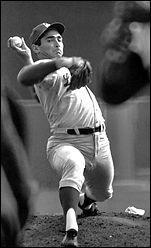
LOS ANGELES, CA -- Former Los Angeles Dodgers pitching great Sandy Koufax announced today that he remains adamant in his refusal to pitch on the Jewish holy day of Yom Kippur.


(Left) The feared hurler as he appeared to opposition batters. Koufax won 165 games during his illustrious career - but none on Yom Kippur.


The 70-year-old Hall-of-Famer, who last threw a ball in competition in 1966, stunned the baseball world in 1965 when he refused to pitch the opening game of the World Series against the Minnesota Twins due to its falling on the Jewish “Day of Atonement.” In a packed press conference today in the parking lot at Dodger Stadium, the left-hander said his feelings hadn’t changed.

Addressing reporters with the same steely-eyed determination he used to intimidate an entire generation of National League hitters, the famed southpaw spoke forcefully. "If I get a phone call and get asked to pitch, and it falls on that day, the answer is still no," Koufax said. "That's not to say I couldn't do it; the arm's feeling pretty good. Hell, I pitched shutouts on two days’ rest, just think what I'd be able to do after forty years.

"But it's a matter of principle,” he added. “If they call me in, I just won't go. If they hand me the ball, I just won't throw it."

Koufax, who now owns and operates a small kosher deli in the Brentwood Hills section of Los Angeles, abruptly ended the conference after announcing that he would also refuse to pitch on Rosh Hashana, Labor Day, the Friday after Thanksgiving, Christmas, Arbor Day, and any day falling in the month of Ramadan.


Wednesday, September 27, 2006

Opera Notes

By Hadleyblogger Drew

I was going to link to that piece about the German opera that Judith wrote about yesterday as well, but after what she wrote there's nothing more to be said.

But speaking of opera criticism, check out the Star Tribune review of what appears to be yet another mediocre staging from the Minnesota Opera , an organization that seems to have forgotten two things: 1) the opera's supposed to be theater as well as music, and 2) people don't really care about your pet ideological ruminations as much as they do seeing and hearing grand opera. (Favorite line: La Donna del Lago was "a feast for the ear rather than the eye.") Get the point?

Now, if you want to see a great opera rip job, check out this review by Jay Nordlinger in the New York Sun of the Met's opening night performance of Madama Butterfly. You have to read the whole piece to savor the true flavor, but I'll give you a few samples:

"I had not thought it possible for Mr. Levine - the all-understanding and all-expressing - to conduct with such indifference."

"Throughout Act 1 [Cristina Gallardo-Domas, portraying Butterfly] was quavering and uncertain, missing several notes. She was also repeatedly sharp."

Marcello Giordani (Pinkerton) was "in wretched form: full of tension, straining, lunging, braying. . .Plus, he was a stranger to rhythm, and almost to pitch."

About the puppet used to portray Sorrow, Butterfly and Pinkerton's son: "From my seat, this item looked like Yoda, the big-eared creature from "Star Wars." This may be a child only a mother can love."

Ouch!

Nordlinger notes that for all that, the audience seemed to enjoy it. I'll have to check around the rest fo the opera blogosphere to see what others think.

RIP

By Hadleyblogger Drew

Two passings I thought should be noted this week:

Sir Malcolm Arnold, the British composer and conductor, died on Saturday at 84. Most people in this country might remember him (if at all) as the Academy Award-winning composer of the score for The Bridge on the River Kwai, but there was a lot more to him than that. As the Telegraph obit points out, he came along at a time when the in-thing was atonal music in the fashion of Schoenberg. The lush sounds of a Vaughan Williams were already becoming "old fashioned," and Arnold risked being labeled a lightweight with his "jolly," "bright" music. But there was even more to this varied musician than that:

He admitted once in an interview that the major influences on him had been Berlioz, Mahler, Sibelius, Bartók and jazz (he wrote a clarinet concerto for Benny Goodman). These adumbrate a style in which primary colours predominate, with added harmonic complexity and, most of all, a profound knowledge and understanding of the orchestra, deriving from his years as an orchestral player.

Arnold endured a difficult, perhaps a typical, artist's life. according to the New York Times: "a diagnosis of schizophrenia in his early 20’s; heavy living, heavy drinking; and mental breakdowns so devastating he was institutionalized several times and had a range of treatments that may or may not have included a lobotomy." For the last few years he was under the care of a full-time caregiver. It was a harsh toll to pay for art, perhaps, but he leaves us much to remember him by: nine symphonies, seven ballets, concertos, and a huge range of music for chamber ensembles, chorus, brass band and more.

*****

And then the is the hall-of-fame golfer Byron Nelson. They called him "Lord Byron," this man who died in his native Texas yesterday at the age of 94. But Byron Nelson was as American as they came. He didn't have the steely aura of Hogan perhaps, or the flair of Snead - two of his principal rivals. He had enough, though.

He was a modest man - "gentle", "grace", and "style" are the words most often associated with him. He was reluctant to talk about his accomplishments, but he left a bagful of records to speak for his place in history: the staggering season of 1945 when he won 11 straight tournaments and 18 overall. He finished in the money in 113 consecutive events. He won 54 PGA Tour events overall, including the Masters in 1937, the 1939 U.S. Open and the PGA Championships in 1940 and 1945.

The shadow that Tiger Woods casts over golf today is an enormous one, and most of the talk surrounds Woods chasing Jack Nicklaus' record of 20 major championships (including, as I do, the two U.S. Amateurs that Nicklaus won). But every few years, when Tiger goes on a tear as he did this year, you'll hear discussion about Nelson's consecutive-victories record. It seems at times inevitable that he'll catch the Golden Bear; perhaps, although I think it's more unlikely, he'll match or surpass Nelson's record as well. But there's one legacy Tiger probably won't surpass, and in that he won't be alone, nor should he be ashamed. For there are few in golf, or anywhere for that matter, who can match the legend of Nelson the man.

Byron Nelson once said, "I want to be remembered as a good man and a Christian man. That's all that really matters." Indeed.

Related Posts Plugin for WordPress, Blogger...