Wednesday, September 6, 2006

This Just In

By Steve

Aussie Police Searching for New Suspects in Irwin Killing
Single Ray Theory Coming Under Increased Suspicion

QUEENSLAND PARK, AUSTRAILA -- Police investigating the death of media naturalist Steve Irwin are reportedly searching for new suspects in the case just days after it was originally thought to be the work of a single stingray that allegedly stabbed Irwin in the heart with a poisonous barb.

“We’re finding it very hard to accept that a single ray, acting alone, was able to bring down this wily and experienced outdoorsman,” said Detective Inspector Keenan Wallabee, referring to growing speculation that what appeared at first to be an open-and-shut case might not be so straightforward after all. “I mean, this man hog-tied crocodiles before breakfast, for land sakes, and now we’re supposed to believe that some squishy little semi-fish that kids hand-feed in zoo ponds was able to do this by itself. I’m no conspiracy nut, mate, but who’s going to believe that?”


(Left) A stingray similiar to that pictured here currently stands [sic] accused of killing Steve Irwin


Suspicions first arose after the discovery of an amateur video tape that purports to show the gruesome incident. The tape, belonging to an elderly tourist, Mr. Abraham Zapruder Jr., who was filming at the beach where Irwin was snorkeling at the time of the attack, has not been made public. A government official who has seen it, speaking off the record, says it raises more questions than it answers.

“You can see the ray all right,” said the official, speaking on condition of anonymity, “but you can also see a shadowy dark object come in to the frame of the picture from this sandy knoll off to the right. It’s hard to make out, they’ll have to do more analysis, but there’s definitely something maybe there.”

CNN legal analyst Roger Cossack said such statements could prove damaging to any future prosecution of the suspect ray. “When you have police officials making these kinds of comments, casting doubt on their own evidence, what’s the public going to make of that?” Cossack said last night on Larry King Live. “If I’m on the defense team, I’m going to keep drilling it into the jury’s consciousness. The police aren't even sure of their own case. If that’s not reasonable doubt, I don’t know what is.”

Investigators, perhaps trying to downplay such speculation, are discounting rumors which have spread on the Internet since Irwin’s death, suggesting a link between the stingray and the similarly-named James Earl Ray, convicted assassin of Dr. Martin Luther King, Jr. Officials were quick to point out that Ray died in 1998 and that, while the average life of a stingray can be up to 30 years, such a connection was unlikely.


(Right) The so-called "Magic Stinger," which skeptics contend could not possibly by itself have caused Irwin's death.


The Zapruder tape, however, has fueled interest in what some are now calling the “Sandy Knoll” theory. Irwin’s television crew apparently captured the attack on tape as well, but Zapruder’s tape, made from a different angle, supposedly documents the chaotic moments after Irwin’s rendezvous with disaster, when his crew ceased filming to run to the stricken superstar’s aid.

Zapruder, now in negotiations with major cable outlets for the footage, agrees that something seems amiss. “It was strange the way Mr. Irwin acted after the stingray jumped at him. He kind of fell toward the ray when you think he’d be jumping back. It's almost as if there was some type of force or impact from behind propelling him forward. You can see for yourself just as soon as the lawyers get all the contracts signed.”

Local police, meanwhile, are still holding the lone stingray in custody while the investigation continues. The ray has made no public comment since its arrest, but has reportedly asked for legal assistance from a representative of the National Wildlife Fund or the Cousteau Society. Plans are to move the ray to a more secure location on Sunday morning.

Tuesday, September 5, 2006

I Rest My Case

By Hadleyblogger Drew

From last week's Mallard Fillmore comic strip (assuming you all know that's a conservative comic):

"A celebrity charged with drunken driving early this morning spewed a string of anti-Christian slurs that could affect his career...

"...he's just been offered two movie deals, a record contract, and his own TV show."

(Rim shot)

Which was the point I've been trying to make the last couple of weeks. I'm not the only one who thinks there's a double standard.

P.S. It's much funnier if you click here and see the strip for yourself!

Günter's A** Is Grass

By Hadleyblogger Drew

Just to show you that some things never change, Mitchell called my attention to this item from his vintage TV Guide collection that he thought I might be interested. From the November 11, 1967 issue, it's a program called "The Creative Person," which aired at 8:30 p.m. on Friday, November 17 on channel 2, Minneapolis' local PBS station (or educational TV, as it was called then). The creative person in question is:

Günter Grass, playwright, novelist, poet, sculptor, painter - and political activist. The life of this creative person is profiled as films show him at home in West Germany, at a political rally (urging voters to defeat neo-Nazi candidates) and reading his poetry at an air force base.

As we know by now, Grass' "creativity" extended to covering up details of his own Nazi past. Wouldn't you like to know what he told the people at that political rally? Bet it wasn't, "Do as I say, not as I do."

Thursday, August 31, 2006

On the Cusp

By Judith

When I was about 12 or 13, there were some days when I couldn't figure out if I was still a kid or had moved on to being grown-up. Should I play with my Barbie dolls or try on jewelry?

This, the last day of August had that same kind of indecision in the air - is it still Summer or is Fall coming on? The sun beat down from a cloudless sky and caused beads of sweat to accumulate on my arms. The dampness of the soil combined with the scent of the plantlife in the park and the warmth of the sun on the grass gave the air a hot, musky smell that said, "Yes, Summer's here and always will be."

And yet, when the breeze kicked up it had the definite feel of crispness that goes along with bonfires, football and pumpkin pie. Crickets only get big enough to make a sound when they rub their legs together towards the end of Summer. Today you could hear them over the coursing of the waters at St. Anthony Falls (granted, there's been so little rain this year that the falls look more like a giant water slide). This is the eighth day of the State Fair; we're 2/3 of the way through now. No doubt about it, Autumn is just around the corner.

I could appreciate Fall more - the brilliant colors of the sugar maples, sunny days with a snap in the air, a new sweater from Land's End - if it weren't followed by that "W" word. That mind-numbing, soul-killing, butt-freezing season of interminable length that can't even keep itself clean. I wish I liked Winter; there's so much of it that I'm writing off a good part of the year. But Winter and my circulation (or lack thereof) just don't get along, so I'll continue to take advantage of days like these and keep them in the hard drive of my brain to replay when there is no sun, no warmth, no chirping crickets and remember when Summer wasn't ready to give up just yet.

This Just In

By Steve

Judge Holds Lawyer in Contempt

PENSACOLA, FL - Superior Court Judge Horace Draper announced from his bench yesterday afternoon that he holds local lawyer Peter (Pete) Peterson in contempt. The silver-haired jurist outlined his findings in a damning indictment of the liability lawyer’s shortcomings. "The way he dresses, his butchering of the English language, his inept legal skills. That irritating lisp. I don’t even like the way he combs his hair. Let’s face it, the man’s a mess.

"He’s never appeared before this court," Draper continued, "and I hope to God he never does, but the man’s contemptible nonetheless."

Peterson was not immediately available for comment following Judge Draper’s declaration, but later that afternoon his secretary told a group of paralegals while standing around the coffee machine that Peterson wasn’t all that fond of the judge either.

Tuesday, August 29, 2006

The Morality of Art, and the Artist

By Hadleyblogger Drew

I know, I keep meaning to get to the pieces I’ve promised on the relationship between art and artists. In particular, I meant to write on the moral dilemma posed by the Nazi era and the artists who were, willingly or unwillingly, part of that movement.

The Nazi angle is the one most interesting to me, since the word Nazi itself has become one of the most pejorative terms we can use against someone else. Nazism, along with Communism, is one of the defining ideologies of our time. As an accusation it’s often used indiscriminately and incorrectly. I ask myself whether most of the people who use it even understand what it means.

Besides, that’s the topic I’ve been asked to write about, and I try to deliver on my promises when I can.

But I keep getting sidetracked, and in the meantime Terry Teachout has another excellent piece that really capitalizes on the areas most of interest to me, and even though I wind up interrupting myself I can’t help but stop and interject his comments, since they’re so much a part of what I’m looking at.

Last week I wrote about Günter Grass and the revelation that he’d been in the SS during WW2, as a segueway between discussions on Elisabeth Schwarzkopf and Leni Riefenstahl (intended to be my next piece). Teachout picks up on the Grass discussion, and leads to the broader points I’ve been intending to write about. He begins with a question offered by a reader:

Apropos your post on Günter Grass, here is a question for you: are there any circumstances under which an artist's personal failings must require him to forfeit his art? Extreme example: what if Tristan and Isolde had been written by Hitler himself—should it ever be performed? And if not, where is the line to be drawn?

After considering the question, Teachout reframes it as:

is there any act so absolutely heinous that the works of a great artist who commits it should be permanently banned from circulation? Asked in that way, the question admits of a wide and interesting range of possible answers, but what I find even more interesting is the fact that it’s impossible to come up with a real-life case that fills the bill.

[…] So far as I know, the only classical composer ever to have committed murder was Gesualdo, who killed his first wife and her lover. Though Richard Wagner was by all accounts a first-class bastard, he didn’t send letter bombs to music critics, and his anti-Semitism, gross and despicable though it was, never led him to advocate the use of Zyklon B on European Jewry, or anything remotely approaching it.

[…] Having said all this, let me return to the thought experiment originally proposed by my correspondent: I wouldn’t have any objection to placing a permanent ban on performances of Tristan und Isolde if it were to be revealed tomorrow morning that Hitler, not Wagner, had composed it. I wouldn’t support such a ban, but I wouldn’t actively oppose it, either, any more than I oppose the informal Israeli ban on public performances of Wagner’s music.

[…] Yes, Wagner was a great composer, one of the most important and influential figures in the history of Western music. You don’t write people like that out of the history books—you can’t. Like it or not, his music will always be played. But I don’t think music is the most important thing in the world. [Emphasis mine.] Music doesn’t inspire people to commit mass murder—it takes ideas to do that. And for that reason, I think it’s fitting that in at least one part of the world, Wagner’s music is rarely played in public because of the ideas of the man who wrote it. What’s more, I think Wagner himself might have understood. After all, he took his own ideas seriously, and he of all people would surely have appreciated the fact that so do the Israelis.

To answer that, we might look at a secondary issue to that posed by Teachout, but one that logically extends from it: whether or not we allow the particular political affiliations of those artists to influence our judgments on their art. Previously, I offered the opinion that former Nazis tends to be much more harshly judged than, for example, former Communist (unless they’ve become virulent anti-Communists. John Dos Passos, for instance, saw his literary star diminish considerably in the mid-20th century as the one-time liberal moved more and more toward the right side of the political spectrum and against Communism. Was his writing that turned the critics off, or his alienation from their precious progressive politics?)

I think the key sentence in Teachout's piece is this: music isn't the most important thing in the world. Put another way, in a broader context: art doesn't forgive everything. And while that certainly applies to Wagner, it has to work both ways. Too many times liberals are only too willing to forgive the politics of one of their chosen - Günter Grass, let's say - because of the ideological content of his art. Do we allow Roman Polański's art to forgive the crime he committed, the crime that keeps him out of this country to this day? On the flip side, does Mel Gibson's recent action condemn his art, a kind of guilt by association? And what do we do with artists like Aaron Copland, who were at one tine associated with the Communist Party?

Can pure art ever override all other considerations, or does it become merely a pawn in an ideological discussion? Is such art compromised even if the values of the artist aren’t explicitly represented in the art itself? Broad questions, ones that I can only take a stab at in the future.

I only have two problems with Teachout: he's a better writer than I am, and he works quicker than I do. But I'll keep on trying.

Our State Fair Is a Great State Fair

By Judith

In Minnesota, 'tis the season - for the Great Minnesota Get-Together known as the Minnesota State Fair. Not just a regional county fair, but a fair for all the state. Back in 1858 when Minnesota was admitted into the Union, the fair was already four years old, having been a territorial fair up till then. Once Minnesota became a state, the fair continued, although it was a movable feast until it landed in its current location in Saint Paul in 1885.

The third largest fair in the country, our fair has grown and changed - and stayed the same. Perhaps the most exciting thing about going to the fair each year is the anticipation of how everything will be exactly as it was the year before. Oh, there may be a new food, the racetrack at the Grandstand may be gone, but the changes are, for the most part, slow and gradual, like the subtle changes to the landscape surrounding its neighbor the Mississippi River. Anything else would put people off. They want to remember the fair the way they first found it when they were kids.

At the fair, there's something for everyone. For very small children there are rides that barely get off the ground but are exciting anyway. For teens there's a basketball challenge and a skateboard demonstration park. For those who appreciate arts and crafts, there's the Creative Activities or Fine Arts building. For the world traveler, there's the International Bazaar. For the farmer, or anyone who appreciates the rural life, there are not only horse, swine, poultry and sheep barns, but Machinery Hill. Once a display of the latest tractors or combines, it now also includes the best of suburban lawn riding mowers.

And for everyone, there's food. Not just food, but food on a stick. Hot dogs, pork chops, pickles, twinkies, deep-fried candy bars and mac & cheese. All on a stick. For the less adventurous, there are also bright yellow ears of corn dripping butter, a crisp, juicy apple or all the milk you can drink for a dollar.

From the Midway to the Space Needle, from the Coliseum to the Grandstand, the Minnesota State fair has something to delight and satisfy all goers. See the hucksters in the Merchandise Mart selling a knife that will cut your wood and your tomatoes. Or how about that floor mop that will sweep and wash. Ride the gondolas and see the fairgrounds from atop the trees. Visit the television or radio station booths and get an autograph from your favorite news anchor. Visit the booths of your favorite politicians and give them a piece of your mind. On Sundays visit the Chapel. Stop in at the newspaper office and watch how old printing presses were set up and run. And before you leave, use the sample newspaper to fold into a "press-boy" cap.

There's so much more that it's impossible to list it all (but you can see a bit more here). We can easily spend twelve hours there on the first Saturday and at the end of the day make a list of all the things we didn't see that we'll catch on the next weekend. And going twice means we can have another helping of cheese curds. Trust me, tastes much better than it sounds. Twelve days of fun and excitement, culminating on Labor Day, signals the end of summer, the beginning of autumn and the feasts and celebrations of harvest before the long, cold winter of the Northern Plains.

Monday, August 21, 2006

The Scarlet Swastika

By Hadleyblogger Drew

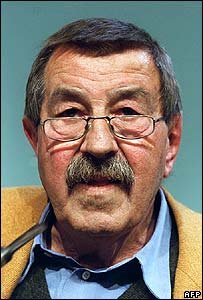
The man on the left is Günter Grass: Nobel-prize winning novelist, author of the magnificently disturbing The Tin Drum and other books, pacifist and long-time anti-American activist. And, apparently, former Nazi.

My purpose here isn’t to recap what’s been written in the wake of the recent revelation that Grass had been a member of the S.S. during World War II. Rather, I’ve been asked to contribute a few pieces on the stigma which the word “Nazi” still carries today (a sort of Scarlet Swastika, if you will), as a follow-up to the recent story on opera star Elisabeth Schwarzkopf. Virtually every obit noted Schwarzkopf’s past membership in the Nazi party (which she dismissed as something “everyone” had done), even though the question of her involvement with the Nazis had nothing to do with that for which she was best-known, her work in music. (Yes, I’m aware that one could argue her continued ability to engage in music during the war might have been a result of privileges accorded her as a result of her membership, but I’m going to say that’s stretching things farther than I care to go.)

While Schwarzkopf was an interpreter of art rather than a creator of it (which diminishes the significance of the revelation, at least in terms of its relevance to the art itself) there are others who could be said to be creators, and the question then becomes whether or not one can separate the influence of ideology from the creation itself. As Terry Teachout puts it in his thought-provoking Wall Street Journal piece, "The work is what matters most...but artists are human, too." If there is to be a Scarlet Swastika, this is where it may show the most - in the interpretation of the artist's work. But, true or not, is it always warranted?

Which brings us back to Günter Grass. I hadn’t been intending to include Grass in my series, but the timing of this story was too much to pass up. And it ties in to one of the central questions we ask, if an obvious one: is there a double standard regarding the treatment and consideration of past affiliations, whether they be youthful indiscretions or fervent beliefs? There are already those wondering if the left will give Grass a free pass due to his political ideology – a pass that might not be available to someone with, let’s say, a less liberal bent. That Scarlet Hammer & Sickle doesn’t seem to burn quite as brightly as the Swastika does, especially if you’re still part of the liberal brotherhood (witness the cult of personality that still surrounds Alger Hiss, unlike the vituperation aimed at former members like Whittaker Chambers, who renounced Communism in all its ideological forms). Will people take a second look at The Tin Drum in the same way that so many on the left want to rethink, say, The Passion of the Christ? Should they?

It seems as if there aren’t many things that society holds against you any more. Being a former Nazi is one of them. In our post-literate society the word itself is thrown around with reckless abandon, to the point that it’s lost most of its original meaning. But the glow from the Scarlet Swastika is still there, and it would seem as if any discussion of the relationship between art and Nazi politics would, sooner or later, come round to Leni Riefenstahl. That's where I had planned to start this series, but instead it's where I'll continue it in a future piece.

Saturday, August 19, 2006

Heeeere's Our Word

By Judith

Welcome to the new - and we hope - improved Our Word. The colors are the same, but the general look of the site is a bit cleaner and neater we think.

And along with a new look is a slightly new attitude. It's been said that the two things you don't discuss in polite society are politics and religion. Well, we'll still discuss them, but we're not going to fight about them. Life is too short and we just have other things we want to accomplish.

We'll be concentrating on the arts, culture, humor and other things that catch our fancy - all with a perspective that is informed by our faith and beliefs. We'll also be welcoming more frequent guest-post-ers, such as Bobby & Steve (no, not the Twin Cities gas station guys) whom you've already met, and Drew, who will be joining us shortly. And, probably some surprise guests.

Your comments are welcome as always, but if anything gets nasty, we reserve the right to delete your comments. If you'd like to contact us, email us at hadleyblog - at- yahoo - dot - com. Again, your comments may be posted, but we'll always give you credit.

Welcome, we hope to see you often at Our Word and Welcome To It.

Friday, August 18, 2006

From the Bookshelf

By Judith

Back in June we started watching the History Channel's 12-part series called "The Revolution." An appropriate series for the 4th of July season (every holiday has a season now; it can't just be one day). To really get in the mood for the big day we also watched A&E's "The American Revolution," a multi-part series first aired in 1994 (Ok, so the tapes have been hanging around for 12 years. Sometimes we just can't get to things right away.) Both shows have their own take on things, although they are laid out the same way; after all, A&E and the History Channel are owned by the same consortium. The current show, "The Revolution," probably could have been a lot shorter if they hadn't insisted on recapping not only the previous week's show, but what just happened before the commercial break.

It's a fascinating period in history, so watching both shows, as well as our annual viewing of the musical 1776 (and The Music Man; watch it, you'll see why it's included) was a great way to get into the swing of things. So what does all this TV and movie watching have to do with reading, as the title of this piece suggests? Well, I may be slightly O/C when it comes to learning - if I read one book by an author, I tend to read everything the author wrote. If I find a topic interesting, I'll read 10 or 12 books on the subject. I'll read in themes (this Lent it was the 7 books of The Chronicles of Narnia, the 3 books of Lewis' Space Trilogy and a biography of J.R.R. Tolkien. Didn't have time for the Ring. One summer I read long novels: War and Peace, Doctor Zhivago and Hawaii).

So, in addition to watching holiday-related programming, I've been reading books about the founding fathers. Four Days in July by Cornel Lengyel was written in 1958 and is the "story behind the Declaration of Independence." In many ways reading the book is like watching a historical reinactment documentary. Written as a story, as opposed to a straight history, it includes what might have been a conversation between two participants in the drama, even though there is no documented evidence that these precise words were spoken. It is the spirit of what might have happened. There are plenty of quotes and notes, but it reads like an exciting story, which of course, is what the history of the beginning of our country is.

Richard Brookhiser is a tremendous writer as well as being a thorough documentarian. In America's First Dynasty (2002) he follows the course of the four great generations of Adamses: John, John Quincy, Charles Francis and Henry. From John's birth in 1735 to Henry's death in 1918, the Adams family made a great impact on American politics and society. Voluminous writers, most of the Adames, men and women, kept diaries so complete that it takes a whole library to hold them all. Like many families, the Adamses had their share of joy and sadness. The difference was that theirs was played out upon the public stage. Granted, they put themselves there, but in addition to personal ambition, they had an overwhelming sense of duty and felt it necessary to serve, even at the cost of their privacy.

Mr. Brookhiser presents these people, warts and all, as does Paul Nagel in Descent From Glory, another look at the Adams family from 1983, just after some of the papers that were previously kept from the public were opened for scholars to peruse. While Mr. Brookhiser's book focused mainly on the professional life of the subjects, Mr. Nagel delves into the diaries - and the personal lives - of the family. While he is a slight bit delicate at times, perhaps not wishing to add additional appearances of scandal, he still tells the straight story.

The current book in the pipeline is Setting the World Ablaze: Washington, Adams, Jefferson, and the American Revolution by John Ferling (2000). This book compares and contrasts the lives and careers of the three men and brings them together in the struggle that gave birth to our nation.

There are still more volumes from our library on the period: Richard Brookhiser's Founding Father and Alexander Hamilton: American; Washington: The Indispensable Man by James Thomas Flexner (the short version); Benjamin Franklin by Carl Van Doren. Then we move on to Miracle at Philadelphia by Catherine Drinker Bowen, although I find the events around the Declaration and the Revolution to be the most interesting.

The most fascinating thing about these men - and the others who took part in this endeavor - was how, being so greatly flawed, they could perform so brilliantly and become icons to Americans of succeeding generations. The more I read about how weak they were as human beings, the more I admire them for what they were able to accomplish. Their virtues - duty, honor, self-sacrifice, discipline, perseverance - helped them beyond their shortcomings and made them answer the call. They were needed and they responded. Would that there were men of their statesmanship and brilliance today.

I believe that there was something else that bolstered them in their arduous tasks. Faith. Modern historians like to make all the founders out to be Deists. Jefferson, to be sure, was a true child of the Enlightenment, but when Washington and Adams called upon the Almighty, they truly thought He was almighty. They viewed God as being interested and intimate, that when they prayed He heard and cared. Perhaps knowing that their prayers mattered gave them the extra strength they needed to carry on. And perhaps we could all learn that lesson from them too.

Thursday, August 17, 2006

In Praise of Satire

By Judith

While we've been doing other things, M&J have, from time to time, invited a few friends currently without blogs to write some pieces. Our friend Hadleyblogger Bobby has contributed on a number of occasions, and, more recently, Hadleyblogger Steve has joined the fray. In a salute to the bitingly funny satire of The Onion, Steve makes comment on today's headlines, as in the recent "Tomorrow's Headlines Today" (7/30) and "And Now for Sports..." (8/16).

We think Steve has an eye - and an ear - for mimicking news stories and look forward to seeing more from him. We hope you do too. Onion, are you watching?

Wednesday, August 16, 2006

This Just In

By Hadleyblogger Steve

Coach Praises Team's Mid-Season Form After DWI Arrest

ST. PETER, Minn. - At his daily press briefing, Minnesota Vikings head coach Brad Childress pronounced himself satisfied with the news of wide receiver Koren Robinson's arrest for two counts of DWI in connection with a high-speed police chase Tuesday night in Mankato.

"This just demonstrates that our squad is hitting mid-season form weeks ahead of schedule," said Childress, obviously pleased with the latest criminal developments surrounding his team. "We've had so many transitions this year - a new head coach, new ownership, a new starting quarterback, a whole new system, really. Naturally, we wondered how the players would deal with it, whether they could live up to the tradition this franchise has established. This incident shows we're there already."

Robinson allegedly had a 0.11 percent blood alcohol level when finally pulled over by the police after leading them on a chase that at times topped 100 miles per hour. He is also facing misdemeanor charges of reckless driving, careless driving, and driving after a license suspension. He wore an orange jumpsuit and ankle shakles in his court appearance earlier today.

"That has to make you feel good," said Childress. "The Vikings are purple-and-gold, but we've always felt very comfortable in orange, too. And when we're comfortable and in our routine off the field, you just know that has to bode well for what's going to happen on the field as well. This is what the Minnesota Vikings football team is all about - our opponents know it, our fans know it, and the local police departments know it." Referring to Robinson's triple-digit speed during the chase, Childress reminded reporters that he has constantly stressed the need for quickness at the wide receiver position. "Koren just stepped up to the plate and showed us all a new dimension," he said with satisfaction.

Asked whether Robinson faced any team disciplinary action for his infractions, Childress was noncomittal. "This is still the preseason - hell, we've only played one game. It's way too early to determine team leadership for the regular season. I mean, who knows what other kinds of misdemeanors and felonies the rest of the team may have in them?"

Childress concluded the briefing with an optimistic analysis of the upcoming season. "Like I said, we usually don't see this kind of activity until we're several games into the regular schedule. We're way ahead of our timeline, and you've got to feel good about that."

Ten Questions

By Hadleyblogger Bobby

Most of you have probably seen the latest blog meme asking you to name ten books that have affected your life in various ways. I thought it might be fun to answer this question with a twist - ten pieces of music (opera, showtunes, sacred songs, etc.) instead of books. Here goes:

1. One piece of music that changed your life.
Manon Lescaut by Puccini. My first, it taught me the virtues of attending opera. It was in May 2001 -- I never thought one opera led to more.

2. A piece you've listened to or performed more than once.
"The Majesty and Glory of Your Name". The sacred selection from Linda Lee Johnson and Tom Fettke was on the May 23, 2004 selection for my one year in choir. I called that song one of the two greatest 20th-century masterpieces -- the other was Carmina Burana from Carl Orff. Both selections are wonderful -- the former I sang, the latter I've watched.

Tragically, we won't do it at church again because our church music leader announced a change to an all-karaoké format using exclusively pop/rock/hip-hop from one music publisher (BMG). The songs our leader now uses are worthless pop junk, and I can't see myself singing it because technique must be violated in order to "sing" this material! It does not have any message, as it focuses squarely on the beat. Besides, I’ve imposed a “no prerecorded accompaniment policy out of respect to the instrumentalists I have used when I sing. Consider I've paid cash and merchandise to my pianists and actually worked with my voice teacher in booking them, it's important I reward them for work.

3. A piece you'd want on a desert island.
I am still a whippersnapper on opera, but I'd love to go for the entire selection of sacred music from Johann Sebastian Bach.

4. A piece that made you laugh.
Gianni Schicchi by Puccini. I'll never forget this for an interesting reason. I was 26 and began taking voice just two and a half months earlier for the first time. My teacher was in the first of the Two by Puccini series. At intermission, she shed her costume for street clothes, and sat behind me (!) to attend this. The unethical manner of Buoso's will had me giggling, and a week later, in my last lesson of the session, she appeared, and we developed a friendship.

A Rush Limbaugh parody of the famous aria (O mio babbino caro) from that opera sometimes has me quoting Mike Joy, asking that the offender be headed to the Oval Office. (In NASCAR Nextel Cup racing, the mobile trackside office is sometimes called the "Oval Office" for its logo on the office.)

Speaking of the Oval Office, the MTV Video Music Awards are coming soon, and I am firing the engine in the truck, bringing a few friends (all classical), and loading the truck to we can arrive to write summons.

5. A piece that made you cry.
Carousel by Rodgers and Hammerstein. Billy Bigelow's death, and the consoling of Julie Jordan had me on the edge of my seat, worth that 2 1/2 hour drive in Darlington County (thanks to the idiot judge in Texas who told NASCAR to take away the Nextel Cup's Grand Slam by taking a major away from Florence-Myrtle Beach [Darlington] for a so-so race at Fort Worth, and teams dislike that!) that April evening.

Keep in mind it had been less than 20 weeks since those last days in the hospital as my father lost his battle with stomach cancer, and I kept my composure during those days. The first persons I went after his death were the college chaplain I had whilst a student, and a friend who runs the state chapter of the National Right to Life organization. I didn't feel strong to be around family after one member of the family actually wanted my pastor thrown out of the hospital room.

6. A piece you wish had been written or composed.
One about the stupidity of the judicial activists who are destroying the country. I'd love to see an opera based on the books of Ann Coulter or Bill O'Reilly, or in support of Our Brave Troops.

7. A piece you wish had never been written or composed (or performed).
For me? Any of the "modern worship" or the "A Praise and Worship (Holiday)" programmes, especially from Bertelsmann. It is doublespeak for "rock and roll spoken here". Teens think jeans, tee-shirts, shorts, and ragged looks are appropriate for church. The kids love the idea that the message doesn't matter, and only the beat matters. This means if the song has a good beat, regardless of message or no message, do it. Not a good thing.

It seems now the adage is get the new album from Chris Tomlin or the next hot "worship leader", then get the guitar tablatures, and play the songs the next Sunday. It turns church into a Top 40 radio station, and more adults are growing concerned of this. Too many have sold out to the virtues of MTV. I can't stand it. I am not 18. (For more on the effects of this kind of music, check out this article.)

8. A piece you're currently listening to or performing.
I am working on an art song, "Ein juengling liebt ein maedchen" and enjoying my first foray into German.

9. A piece you've been meaning to listen to or perform.
Handel's Messiah.

10. A CD you've bought but haven't yet listened to.
I haven't purchased a new CD that has not been listened, but I would like to get the Ohio Lyric Opera CD's which included Jami Rhodes. Jami is my teacher's friend, they did a recital in their last week of grad school, and they are friends to the point she helped me in my informal recital at my teacher's home.

As for passing it on, anyone care to add their own choices?

Tuesday, August 8, 2006

Carmen, Miranda-ize her

By Judith

The last time I reviewed a Minnesota Orchestra performance of a concert-version of an opera, I'd had the advantage of being able to compare it to the Minnesota Opera fully-staged performance of the same work (Tosca). This time, the performance will have to stand or fall on its own, as I missed the Opera's offering of Carmen in April 2005.

And stand on its own it can. The Saint Paul Chamber Orchestra had better watch out - the Minnesota Orchestra is turning into one fine opera orchestra. And the way the Minnesota Opera has done so much "minimalist" staging recently, this partially-staged performance rivals their fully-staged ones.

Bizet's gypsy Carmen is a women dead-set on living life on her own terms. While seeming to be strong and self-assured, one wonders whether her flirting and flitting from one man to the next hides a deep insecurity and fear of being hurt. At any rate, she is a complicated character and it takes a talented actress to keep her from being a caricature. Angela Horn is such an actress. An attractive woman, Miss Horn is a believable temptress - and a mighty fine castanet player, too. The voice, however, was not up to her other attributes, often getting lost in the lower register when competing with the orchestra or other voices. Her upper register was strong and clear and not a bit strained.

As the bullfighter Escamillo, Stephen Powell was a loveable ham. A rich voice and a slightly over-the-top arrogance made him a perfect toreador. His entourage, carrying clipboards and wearing Ray-Bans, fawned on him and kept the groupies and autograph-seekers at bay. Bullfighter as rock star. Marvelous.

Jennifer Baldwin Peden played the teen-aged Micaela, dutiful and faithful to the errant Don Jose. Miss Peden's voice was high and thin like a cirrus cloud and conveyed the sweetness and innocence of the character. This might have been a deliberate production and the voice may have more meat to it in other roles.

The highlight of the evening was Roy Cornelius Smith as Don Jose. And, indeed, his reception at the curtain calls was louder and warmer than anyone else's, although each singer enjoyed a heart-felt ovation. Mr. Smith was a short-notice substitution for the ailing Gordon Gietz. In the first half of Act 1, his voice was a little ragged, as though he had not had sufficient warm-up time. As the opera went on, his voice became stronger until, in the last scene of the last act, it sounded as though he had the strength to easily sing the opera over again.

While Carmen and her friends are drinking at the Lillas Pastia tavern in Act 2, a group of dancers entertains them, a ballet being an almost "must" in opera of the day. Penelope Freeh and her troup of dancers were spirited and talented, remarkably being able to pull off their moves in only a small section of the stage.

The always impressive Minnesota Chorale kicked off their shoes - literaly for the women - and came down from the back of the stage to be characters in the play. Singing without music in their staged portions (although using music when they weren't) they added to the general impression that we were seeing a staged instead of a concert performance. A comparison here to the Tosca performance in May 2006: none of the singers in Carmen used music while all the singers carried music folders with them throughout Tosca, although only occasionally refering to them.

Andrew Litton, a talented conductor and music director did it all this year: conducted orchestral concerts, performed as a soloist and ensemble player and pulled off an ambitious and challenging concert opera performance. Let's hope that the Minnesota Orchestra will perform more opera - during the regular season and during Sommerfest - in coming years.

Friday, August 4, 2006

Elisabeth Schwarzkopf, R.I.P.

The famed soprano Elisabeth Schwarzkopf died yesterday at the age of 90. The AP obit called her "one of the great voices of the 20th Century," which is like referring to DiMaggio as one of the great ballplayers of the 20th Century - accurate, but hardly telling the entire story.

She was compared to Callas, although as Terry Teachout points out, there were critics who saw her as fussy and mannered (a judgement with which he concurs). As the picture on the left verifies, she was indeed "a great beauty," which reminds one of Jay Nordlinger's story about taking a friend to see Schwarzkopf perform. Upon seeing the singer on stage for the first time, the friend gasped, "You mean she sings, too?"

Elisabeth Schwarzkopf was one of those starts whom even non-operagoes had heard of. She came from a time when opera singers were popular stars on radio and television, when the LP had made possible the communication of opera to a much wider audience than the concert hall. As My Favorite Intermissions and others have put it, it seems another sign of the end of an era, the era in which classical music stars were really stars, part of pop culture. In the last two or three years we've seen the deaths of Franco Corelli, Renata Tebaldi, Victoria de los Angeles, Birgit Nilsson and Anna Moffo, among others. Sure, there's Domingo and Pavarotti, Sills, Sutherland and Peters (and Risë Stevens, for those of us who have long memories and saw Going My Way), and Fleming and Bocelli (!) are probably the best-known to those who don't watch PBS, but who will we be mourining fifty years from now?

Ah, but then there was that Nazi thing (her death, ironically, bookends a week which began with the Mel Gibson furor), and in this case it's hard to avoid the labeling since she actually was a card-carrying member of the Party. ("Everybody at the opera joined," Tim Page's obit quotes her as telling the New York Times. "We thought nothing of it. We just did it.") Perhaps if she had been more forthcoming with the revelation it wouldn't have created as much of a furor, but unfortunately Oprah wasn't as big back then. (She was probably the victim of bad PR as well; one wonders if she wouldn't have been more readily forgiven had it turned out she been a member of, say, the Communist Party...)

Add to that how styles had changed over the years, and those charges of fussiness were what took hold and stayed there. One could still admire some of her recordings from the past, but one doubts she'll be remembered with the same affection that, say, Nilsson or Lorraine Hunt-Lieberson were on their passings. But you dismiss her legacy at your own risk. She was most memorable in her interpretations of Mozart and Stauss, Wagner, Beethoven and Wolf, and Prima la musica has a nice appreciation of her career.

Doubtless Teachout is right when he says that her Nazi past hangs over her, and always will. Yet, as he points out, it is possible to appreciate the art without necessarily admiring the artist. We can condemn Wagner the man and still thrill to his music. (Or some of us, anyway.) There is always something of the artist in the art (or should be, at any rate), but the truly great artists always attempted creations that would live apart from them. It is up to us as the audience to judge how successful they are.

As An Unamplified Voice puts it, "She was neither the last, nor the greatest, but she was for a while the most praised. That is something." It is indeed, and as far as it goes perhaps that's enough.

UPDATE: As Ray reminds us in an email, Elisabeth Schwarzkopf's nephew is none other than General Norman Schwarzkopf, the brilliant leader of the Allied military forces in the first Gulf War. What might history be like if Schwarzkopf had been allowed to go into Baghdad right then and there? One can only wonder.

Monday, July 31, 2006

This Just In

By Hadleyblogger Steve

Rider Stripped of Title After Having Failed to Fail Drug Test

PARIS, France - Norwegian rider Pers Häavsrud was stripped of his Tour de France title today after having failed to fail a routine test for performance-enhancing drugs, Tour officials announced.

“Häavsrud has brought shame and disgrace to professional cycling through his actions,” Tour director Jean-Marie Frommage said in an emotional press conference announcing the decision. “By refusing to join other elite cyclists who have used blood doping, testosterone, and other performance-enhancing drugs to great advantage, he has not only cast confusion and suspicion on the rest of the Tour, he has shown how selfish he really is.”

Häavsrud's GlaxcoSmithKline team expressed disappointment in the test results. “If true, Pers will be dismissed from the team immediately,” team manager Raoul Dunleavy said. “Rampant individualism and self-centeredness are threatening to destroy professional sports at all levels. He has let not only his teammates but his sponsor down as well. When athletes put themselves ahead of their sport everyone loses. They must remember there is no ‘I’ in ‘team.’ Or in testosterone, for that matter."

Häavsrud was not immediately available for comment, but said through a spokesman that he planned to bring in Barry Bonds’ former personal trainer to assist him in fighting the charges. “I will not take this lying down,” Haavsrud was quoted as saying. “My involvement in blood doping has been well known amongst my teammates. I am tired of always having to be the, how you say, needle of suspicion.”

Häavsrud also expressed surprise at the negative testing result.

"My body must process these illegal substances differently," he said with a shrug. "What am I to do?"

Thirteen riders were banned from the start of this year's tour for failing to fail their tests, but this was the first time a winner had actually been accused of testing clean since the introduction of stringent new drug confirmation tests. Austrian Hans Hans spoke for many riders in his blistering criticism of Häavsrud. “It’s not easy timing our injections just right to make sure they match up with the unscheduled tests. We have to work hard at it. And now this Swede comes along and passes his test. What’s he accomplished, besides besmirching the hard-earned reputations of so many who dedicate their lives to the Tour?” When reminded that Häavsrud was actually Norwegian, he replied, “Whatever. Piss on him.”

Other cyclists were quick to join the discussion. Elco Advarian, who was suspended from the Tour two years ago for a similar violation but has since completed a Tour-sponsored counseling session and subsequently failed seven consecutive tests, was more sympathetic and suggested that Häavsrud might have been naïve. “When you get into something as big as the Tour, sometimes you’re overwhelmed. You don’t know what you’re doing, you listen to the wrong people, you make mistakes. Failing to fail that test was a mistake I’ll never make again,” the Team BALCO rider added. “Hopefully Pers will learn from his as well.”

Former two-time Tour champion Renaldo Maria Jiminez attempted to explain why the charges against Haavsrud were so damaging. “Sports is about winning, true, but it’s about much more. The world of professional cycling is more like a fellowship. You know, the camaraderie that is built up when riders travel through the circuit together, all of us struggling against the elements, carrying out our secret steroid use, working together to reach the finish line. A great element of trust is required in this sport, and it’s threatened when a rider thinks only of himself.”

Frommage was more blunt in his comments. “We’re trying to run an honest sport here, but when athletes persist in trying to play by the rules they only succeed in making others look bad,” he said. “We’re trying to do something here to rehabilitate the image of this sport, and Häavsrud won’t cooperate. There is no room on the Tour for his ilk."

Norwegian fan and cycling enthusiast Lars Bersvich spoke for many in the tiny country when he asked for his opinion. “I’m not angry,” he insisted. “Just disappointed. But we must look to the future, to the next generation of young Norwegian cyclists who will enthusiastically join in the use of illegal, even toxic substances, and will put the sport of cycling back on its normal course."

Friday, July 28, 2006

Good Words on Poets

By Judith

In his Anthology of Catholic Poets, the poet Joyce Kilmer had this to say on writing poetry:

"There are in this book poems religious in theme; there are also love-songs and war-songs. But I think that it may be called a book of Catholic poems. For a Catholic is not a Catholic only when he prays; he is a Catholic in all the thoughts and actions of his life. And when a Catholic attempts to reflect in words some of the Beauty of which as a poet he is conscious, he cannot be far from prayer and adoration."

Saying it much better than I could, Mr. Kilmer reflects what I strive to do - often not as successfully as I'd like - in my life and in my poetry. Not all of my poems are of a religious nature, but I hope that my faith comes through in all of them.

This, by the way, explains why this blog isn't as active as it has been in the past. While Mitchell works on his novels, I've been working on writing poems, something I used to do in droves, but have let lapse in the past fifteen or twenty years. However, if writing is a gift, and if it is important, then writing poetry is even more so. We'll let you know if we get published, but check back before that for other commentary. There's a much better chance you'll see our thoughts on a blog than in print. But keep a good thought.

Friday, July 21, 2006

For Once, They Got It Right

By Judith

I have my troubles with both President Bush and Sen. Rick Santorum (R-PA), but in the last couple of days, they both have done something right.

First, President Bush exercised his veto power for the first time by vetoing the bill that would have supplied federal funding for embryonic stem cell research, in essence, having our tax dollars used for more murdering of innocent human life. Good one, Mr. President. At the same time, Sen. Santorum's bill supporting adult stem cell research (in which the stem cell donor does not die and which has had more promising results) never made it to the President's desk, being defeated in Congress. Good try, Senator.

But really, what Sen. Santorum said in a speech to the National Press Club on Thursday about Islamic Fascism is as interesting - and courageous. (Although I question the wisdom of his support of the Patriot Act.) Here's a snippet.

There is a bigger problem: our fear of speaking clearly, publicly, and consistently about the enemy. It is unfashionable in some quarters to speak about the Islamo fascists, because of the misguided cultural reflex that condemns anyone who speaks critically about others' practices or beliefs. Therefore, we can’t say or do anything that might offend Muslims. But that's backwards. The real offense to Muslims is to remain silent about an ideology that produces the systemic murder of innocents. Mostly, Muslim innocents. They are the first victims of Islamic fascism, and the enemy directly targets them, as we have heard once again in the most recent audiotape from Osama bin Laden. Those who refuse to criticize Islamic fascism undermine the cause of freedom of religion because if the Islamic fascists win this war, no other religion will be permitted to flourish. Paradoxically, when we refuse to criticize anybody, we end up patronizing everyone, which is offensive to everyone and self-defeating.

For the entire text of his speech, click here.

GKC Strikes Again

By Judith

G. K. Chesterton shows up in some strange places. This time he was quoted in an article about copywriting by Herschell Gordon Lewis called "Synonyms Ain't Synonymous" (Direct magazine, June 15, 2006). Here's the quote:

"As I recall, it was Gilbert K. Chesterton who said,'When two words have the same meaning, one of them quickly disappears.' (To be fair, he also said, 'The only way to be sure of catching a train is to miss the one before it.')"

When in doubt as to where a quote comes from, guess first the Bible, Shakespeare or Don Quixote. If that doesn't do it, it's probably Chesterton.

Friday, July 14, 2006

Wish I'd Written That...

By Judith

A poem by Christina Rossetti (1830-94)

The wise do send their hearts before them to
Dear blessed Heaven, despite the veil between;
The foolish nurse their hearts within the screen
Of this familiar world, where all we do
Or have is old, for there is nothing new:
Yet elder far that world we have not seen;
God's Presence antedates what else hath been:
Many the foolish seem, the wise seem few.
Oh foolishest fond folly of a heart
Divided, neither here nor there at rest!
That hankers after Heaven, but clings to earth;
That neither here nor there knows thorough mirth,
Half-choosing, wholly missing, the good part: -
Oh fool among the foolish, in thy quest.

Monday, July 10, 2006

For What It's Worth

By Judith

"There's something happening here,
What it is ain't exactly clear."

It seemed clear back then. The young were right, the old were wrong. War was bad, peace was good. Conservatives had no feelings and liberals felt everyone's pain. For some of us it's not so much that we've sold out, but that we're buying a different line. For others, well, you'll be going to see Crosby, Stills, Nash & Young this weekend.

In an interview in Sunday's (7/9/06) Star Tribune, Stephen Stills is singing the same old tune. Literally. Along with "For What It's Worth" the group will also be playing all their old protest songs, whether or not the cause is relevant any more. ("Ohio" - about the shooting of four Kent State students.)

And yet, Stills, the self-titled "political centrist" of the group has some valid points. Regarding the war he says, "Putting on a uniform and serving your country is noble, but it is ignoble to throw [soldiers] away the same way as the last four years of Vietnam." Right on, brother. But for Stills and company the solution is to bring all the troops home and never fight a war again. Would that this were possible. The problem with Vietnam and with Korea and the first and second Gulf Wars, and whatever other mess we find ourselves in is that we have lost the drive for victory. It is a waste of human life on all sides if we approach a war without the will to win. Think how it might have been different if George Washington and his men hadn't given their all for six long, grueling years to win our freedom. Sort of makes CSN&Y's "Freedom of Speech '06" tour ignoble.

Stills has another point to ponder. As for the administration, he says, "It's the same kind of disconnect today. In the face of all reason, they're just spouting this blather. And our blather is a lot more accurate, I think. But it's still blather." Amen again. Where I disagree is that his (liberal and/or Democrat) blather is any better than any other blather. There is so little difference between political parties these days; both want to spend your money at an alarming rate, it's just that what they want to spend it on might differ. The Republicans can't even be counted on to support a pro-life agenda.

What the "aging children" don't realize is that nothing will ever change because of the protest songs they write or the picket signs they carry. The only thing that will change the world is our own conversion of heart and our affect on the people around us, one by one. Don't pick up a protest sign, pick up the Cross daily and follow Jesus Christ.

Saturday, July 8, 2006

Competitve Eating

By Hadleyblogger Bobby

Changing the dial around tonight [Monday, 7/3] as I was having dinner, I couldn't believe ESPN2 ran a series of shows based on the past few Nathan's Hot Dog Eating Contests.
Paul Page is the play-by-play announcer for that contest! Sheesh! What's next? John Madden calling one?

Wednesday, June 28, 2006

Where There's a Will

By Judith

How many times have you heard someone say that whenever adversity arises, how you handle it is all in the attitude.

One of Our Word's friends, for example, has this situation in her work place. A key person is getting ready to retire and his attitude has gone downhill. "Not my problem" or "I don't care, I'm not going to be around" is the response when something difficult comes up. Now apparently this person has felt ill-used for some time and there is a great deal to be discussed on how employees are treated. However, having a job and receiving a paycheck implies a certain responsibility to perform the duties of the job regardless of the situation.

Now let's look at how attitude can make a difference. If one chooses to focus on how bad the situation is and wants to play the victim card then that person not only makes himself miserable, but brings everyone else down. If the person decides that he only has a short time left and is going to make the best of it, then he has the opportunity to not only make himself feel better, he can be of service to others and offer up his sacrifice at the same time.

Where does attitude come from in the first place? We all know people with sunny dispositions and those who continually see the world through morose-colored glasses. Is this just nature, or do people largely decide how they will react to situations? Our outward attitude is influenced by our will, and how our will is formed can make all the difference. Have we conformed our will to God's or have we decided to forge it in our own image? Are we going it alone, subject to being tossed by the gale, or are we sailing in the boat with the One who can calm the wind?

There are countless situations in our lives that can be made better by setting our will by God's compass. This doesn't mean that we have to live our lives as doormats or be Pollyannas. It means that even though we may have to put up with things that we don't like, we can still make them an opportunity for grace.

Tuesday, June 20, 2006

Report from the Chesterton Conference

By Judith

So this is what people used to do before television. Listen to interesting people talk on interesting subjects.

To be sure, some speakers present better than others. Whether one has a gift for public speaking or not, it's absolutely essential that the talk is well researched and well written. After that, presentation is a matter of practice. A few of the presenters needed more research and writing skill. Even a volunteer presentation at a free conference deserves the best one can do.

An example of a truly gifted speaker is Dale Ahlquist, president of the American Chesterton Society and author of a number of books and articles on Chesterton. His speech opened the proceedings on Thursday night. He knows his subject inside and out and his presentations contain intelligence, warmth and a biting wit. His talk "Abandon all hopelessness Ye who enter here," provided an overview of Chesterton and Dickens (it was the 100th anniversary of the publication of Chesterton's book on Dickens). As Mr. Ahlquist stated, "Dickens preserved the past; Chesteron preserved Dickens; we're preserving Chesterton."

He went on to explain that pessimism (which is really despair) isn't the opposite of optimisim (which is really presumption). Their opposites are sorrow and joy, both of which can lead to hope.

On Friday Fr. Stanley Jaki spoke on Dickens and Darwin: The Two Who Never Met. I wish I could say that I got a lot out of this talk, but the truth is that between Fr. Jaki's accent and his drifting away from the microphone, I picked up very little. For an interesting account of Fr. Jaki's small seminar on Intelligent Design, check out Ray's post at Stella Borealis.

"Trials and Triumphs of a Chesterton Bibliographer" sounds as though it could have been a dull, academic presentation of a listing of Chesterton's miles of published works. In reality, it was one of the best sessions. Geir Hasnes has been working on pulling together the ultimate list of Chesterton's writings. And what a task it is. Mr. Hasnes' talk was delightfully entertaining, explaining why it was important to do the job, how it was being accomplished and what was left to do.

Christopher Check, Executive Vice President of the Rockford Institute, presented "Chesterton Unplugged," a talk about Chesterton's skepticism about unchecked progress and how technology might not always be our friend. And of course, this was well before computers, television, iPods and cell phones. (Mr. Check suggested we all gather at the river and throw them in.) I agree that technology can be used for ill as well as good and there are great temptations to overuse it instead of following other pursuits such as praying, spending time with family and friends, playing a musical instrument or reading. However, I can't help but think that the ever-populist Chesterton would have been intrigued by the bloggisphere and the opportunity for opinions and ideas to be explored beyond the constrains of the main-stream-media.

The final talk on Friday night was by Joseph Pearce, author of a number of biographies of Catholic writers and editor of the St. Austin Review. He spoke on Chesterton and C. S. Lewis. Mr. Pearce is also a speaker who has had much experience in giving talks and knows how to blend humor and seriousness to bring his subject alive. Of course, having the topic of Chesterton and Lewis helps.

On Saturday morning Adam Schwartz, professor of history at Christendom College, spoke on Chesterton and Malcolm Muggeridge. He spent a good deal of time going over ground with Chesterton that his audience probably already knew and too little time on Muggeridge. Muggeridge was, like Chesterton, a convert to Catholicism. Probably the overriding reason for Catholicism to appeal to Muggeridge was that it was the only religious institution in the world that was solidly, uncompromisingly pro-life. He believed that the sanctity of life was more important than the quality of life; that we cannot pass judgment on what a life is worth, whether in the womb or for the sick and old. His was an all-or-nothing view: either every life is worth living or no life is worth living. And here we also get into Catholic thought on pain and suffering and what a pleasing - and useful - sacrifice the offering of these can be.

We were not able to attend the smaller group discussions in the afternoon, so I'd be interested in hearing how they went.

I think that the conference was what I was expecting. And not. A lot of sitting and listening. A lot of time wandering around the booths of the booksellers. Running into a few people we know. Trying to take in so much information that my brain hurts.

So, give it a try next year. It will be June 14 - 16, 2007. The theme: "The Man Who Was Thursday Through Saturday."

Thursday, June 15, 2006

Chesterton Conference

By Judith

Today begins the 25th annual Chesterton Conference, convening at the Brady Educational Center on the St. Paul campus of the University of St. Thomas. The theme of this year's meeting is "The Best of All Impossible Worlds." 2006 also marks the 100th anniversary of Chesterton's book Charles Dickens, so some of the presenters will be aiming their talks in this direction.

This is the first year that we've attended, so I'm not sure what to expect. To be quite honest, outside of some of the writers for Gilbert magazine, the only speaker I'm familiar with is Joseph Pearce, author of many biographies of Catholic writers and co- editor of the St Austin Review. His talk this year is on C. S. Lewis.

Dale Ahlquist, President of the American Chesterton Society, promises that there will be many opportunities to purchase books, so, although the conference is free, you still need to bring plenty of money, or a little plastic card, if you'd like to defer the pain.

We're looking forward to this year's conference, having missed last year's because we were in the midst of moving. This year, we're almost all settled in, so we can afford to take some time for some fun. We'll report back next week.

Wednesday, June 14, 2006

Peace of Christ

By Judith

The other day while I was combing my hair, looking in the mirror, I saw the cross I wear on a chain around my neck. For a moment I flashed back (sans drugs, honest) to a time when I wore the peace symbol in the same way. You know, the circle girding a straight line with two shorter lines projecting off at a slight angle. And it struck me that the peace symbol was only a step on the road to peace, the peace that passeth all understanding, and it was the cross that was the true peace symbol.

The peace symbol actually began life as a protest symbol for the nuclear disarmament movement. (The lines are semaphore signals for N and D.) For a while the designer, Gerald Holtom, had considered using the cross in the design, but the priests he asked were reluctant to endorse the cross as part of a nuclear protest. He then moved the crossbar down and bent it in the middle and put it in the circle that became the standard of the protest, and quickly found its way into being the symbol of the whole peace movement.

If you’d like to revisit your own “hippie” days, you can visit this website for more info on the history of the movement. But let me copy a snippet of Mr. Holtom’s own explanation of the design:

“I was in despair. Deep despair. I drew myself: the representative of an
individual in despair, with hands palm outstretched outwards and downwards
in the manner of Goya’s peasant before the firing squad. I formalised the
drawing into a line and put a circle round it.”

Isn’t despair precisely the emotion we can overcome by looking to the One who outstretched his palms to be crucified? This despair is what overtakes those who seek the answers to the world’s problems in the world and in themselves. It’s so easy to give way to despair, to throw our arms downward, when, in lifting them up, lifting up our hearts to our Lord Jesus Christ we can find the means not only to cope, but to hope.

Tuesday, June 13, 2006

American Popular Song 101

By Judith

She could have sung all night, and we’d have begged for more. For over 30 years Joan Morris and William Bolcom (married for almost that long) have been wowing audiences with their performances of American popular songs from before the turn of the 20th century to contemporary pieces by Mr. Bolcom. And wow us they did with their recital at the McKnight Theater in Saint Paul on Saturday night (6/10/06). The appearance was part of the week-long Saint Paul Summer Song Festival.

The McKnight Theater, with slightly more than 300 seats, is the perfect setting for performances such as these; the acoustics allow the artists to sing without amplification and the intimate surroundings let the audience be drawn in to the action. Seated about halfway back, we were able to understand every lyric and appreciate each gesture and facial expression.

The program began with songs from the early 1900s including “torch songs” by Ralph Rainger, “My Castle on the Nile” by J. Rosamond Johnson and “On the Banks of the Wabash Far Away” by Paul Dresser (Theodore Dreiser’s brother). Mr. Bolcom would introduce each song and perhaps share an anecdote about the composer before Miss Morris would beautifully interpret it with her rich, mellow mezzo-soprano and gifted acting ability.

Moving on in the century, the couple regaled us with “Hit the Road”, made famous by their friend Eubie Blake and “Say So!” with music by George Gershwin and lyrics by Ira Gershwin and P. G. Wodehouse! And also writing with Wodehouse was Jerome Kern with “Cleopatterer.” Irving Berlin was represented by the lovely “Always” and “Let’s Face the Music and Dance.” (You could almost see Fred Astaire moving across the stage.)

Richard Rodgers partnered with Lorenz Hart before Oscar Hammerstein, and I think, produced better songs. Now, Oklahoma happens to be one of my all-time favorite musicals, but I enjoy the sophistication, the wittiness and near-perfect word manipulation of Hart: “Beans could get no keener reception in a beanery; bless our Mountain Greenery Home.” “Glad to Be Unhappy” from 1936 was the Rodgers and Hart song Miss Morris sang this evening and gave it just the right blend of sadness and irony.

Cole Porter, another with a great gift for lyric, penned a song called “The Tale of the Oyster” and a cautionary tale it is. Miss Morris squirmed and wriggled and grimaced and managed to keep her dignity through it all.

At the beginning of the second half Mr. Bolcom played a solo piece of his own composition, “Graceful Ghost.” He is such a perfect accompanist – supportive and contributory, but not overpowering – that you forget what a talented pianist he is. Later in the program Miss Morris sang three of his Cabaret songs.

There was plenty of humor in the program, too, as with Yip Harburg’s “Lydia, the Tattooed Lady,” made famous by one Groucho Marx. The last of three encores was saving the best for last – a wicked rendition of Kurt Weill meets Julie Andrews with Miss Morris imitating Lotte Lenya singing “My Favorite Things” from The Sound of Music. There was even a bit of Pirate Jenny in there with a vision of “the black freighter” appearing over the top of the Alps.

If you’ve ever wondered what people did before television, radio, and – heaven forbid – before blogging, this concert answered the question. Mr. Bolcom and Miss Morris invited us into their parlor and entertained us with a delightful evening of story and song. After having lived and worked together for so many years, the two are as natural on stage as if they were in the home of friends. And judging by the reception they received, they were, indeed, among friends.

Monday, June 12, 2006

Our Last Word on the Subject

By Judith

Since others have been talkin' like they know, we'd like to say that a very reliable source (no, of course we can't reveal it) has told Our Word that the coadjuter will be Bishop Aquila. There, that's done. Now, no matter who and no matter when, we're done with this story except to say our prayers are with Archbishop Flynn and the new coadjuter. God bless you both.

Friday, June 9, 2006

Wish I'd Written That...

By Mitchell

"This age makes me so sick that sometimes I am almost impelled to stop at a corner and start calling down curses from Heaven."

- George Orwell, letter to Brenda Salkeld, 1934
(with a big HT to Terry Teachout)

Don't Make Me Laugh

By Mitchell

Spellbinding reporting this morning by Star Tribune writer Pamela Miller, who has suddenly discovered, two weeks into the game, that Archbishop Flynn "has asked the Vatican for a coadjutor archbishop with rights of succession." This news flash from "knowledgeable Catholic Church officials," which I would take to mean archdiocesean officials who are desperately trying to spin the story their way. For example:

Flynn, who became archbishop in 1995, has been praised for his personality and leadership. He has been outspoken on some social justice issues and has taken the middle ground on others, and his successor is likely to embrace the same style, observers say.

In other words, forget about a conservative.

Names of possible successors are not the result of leaks from those with real knowledge, [St. Thomas Prof. Robert] Kennedy and archdiocese officials said, but merely speculation or wishful thinking.

In other words, forget everything you've read in blogs.

Auxiliary Bishop Richard Pates, one name often mentioned, is unlikely to be Rome's choice because it usually looks for a successor outside a province, which in this case includes Minnesota, North and South Dakota, Kennedy said.

In other words, forget about Aquila.

And, for those of you out there in the blogosphere who think the Archbishop is a controversial figure, you can forget about that, too. Nary a word of anything but praise:

On Thursday, scholars and clerics praised Flynn. "He is so appreciated by so many people for his warmth, friendliness and care," said St. Paul Seminary Prof. Katarina Schuth, citing as an example his daily delivery of the Eucharist to Sister Ann Ganley, his special assistant, who died Monday.

Bishop Peter Rogness of the St. Paul Area Synod of the Evangelical Lutheran Church in America called Flynn "a fine ecumenical partner who has served the community well as an advocate for those on the margins -- the poor, immigrants."

Flynn's 2002 role in leading a committee of U.S. bishops that drafted the Charter for the Protection of Children and Young People in Dallas was pivotal in helping the church face the sex-abuse scandal, [former America editor Thomas] Reese said. While his leadership hasn't gone far enough for some victims' advocates, "he did a very good job of helping the church begin to clean up a real mess at an extremely delicate time in its history," Reese said.

I'm surprised they had the courage to rule out a woman being the next bishop. Although, come to think of it, they didn't actually say that, did they?

Now, I've got some real problems with this story. Oddly enough, I don't challenge the positive comments about the Archbishop. As I've tirelessly said in the past, there are a lot of good things going on in the Archdiocese - reform at the Seminary, increase in Eucharistic Adoration, good priests, and so on. Much of the credit for that goes to the Archbishop.

And yet, you simply can't deny that Archbishop Flynn's been a lightning rod for controversy. There are a whole lot of groups and a whole lot of people out there who have a whole lot of bad things to say about his leadership in the Archdiocese. This article skips completely over this. It reads, in fact, more like a eulogy than a news story. It gives an incomplete and inaccurate portrait of the true state of affairs here. Not a word about VIRTUS, not a breath on SJA, nary a whisper regarding the Rainbod Sash, not even a nod toward all those priests who opposed his support of the Marriage Amendment. Archbishop Flynn has become one of the best-known bishops in the United States, for good or ill, because of these controversies. And the Star Tribune, as parochial as ever, fails to deliver. For them, it's all kind hearts and coronets around here.

I've often said that you can't ignore the good just because of the bad; now I offer the flip side, which is that the good does not negate the bad. If the Star Tribune was interested in the whole story they would have recognized that. If the Star Tribune wanted to give their readers a portrait of an archdiocese in turmoil, if not transition, they would have looked deeper into the story.

I don't know how Pamela Miller did her research for this article; I wonder if she consulted the blogosphere? (If you're a blogger who was contacted by Miller, I'd like to know about it.) I wonder if she talked with any "Catholic experts" besides Thomas Reese or Prof. Kennedy, the chair of Catholic Studies at St. Thomas? Did she talk with anyone who had even a hint of anything remotely critical to say about the Archbishop? I wonder, in fact, if Miller has anything beyond a dim conception of how the rest of the nation (that is to say, those who take an active interest in these kinds of things) views this archdiocese?

There's always a danger of thinking that events are more important than they are. In using that line in the previous paragraph - the one about "how the rest of the nation" views the archdiocese, I do so with apprehension. After all, most of the nation gives not a whit about what goes on here. For that matter, I'd imagine most of the people within this very archdiocese have little idea about the tensions under the surface.

But if this is a danger, then so too is the danger of disregarding any external importance to a story. The fact of the matter is this: if you read national publications, if you consult national experts, if you make even a cursory Google search, you'll find that there is indeed a great deal of interest in what goes on around here. Great newspapers, if there are any left, recognize that. They have a way of making the big story more intimate, while at the same time realizing the hidden importance of the small story. The Star Tribune does neither, and hasn't in my lifetime. Mind you, I'm not ruling out the possibility that this story could turn out to be completely and entirely accurate, and that Miller knows more about this than the rest of us put together - but it does seem awfully one-sided, don't you think? And I'm not trying to cast aspersions on Pamela Miller the writer - I don't know her myself, and she could be a quite delightful person. I cite her less as an individual and more as a representative of the MSM in general.

(And by the way, that crack from Kennedy about speculation being "wishful thinking" - it's curious, isn't it, that this story first broke on the blogosphere. One would suppose that Kennedy and his ilk would have dismissed that speculation as "wishful thinking" on the part of disgruntled orthodox Catholics. Until it was to their advantage to acknowledge the story, that is. But that "wishful thinking" turned out to be accurate, didn't it?)

But let's not be too harsh on the Strib. After all, it only took them two weeks to catch up with this story. For this lummox of the MSM, that's not too bad.

Tuesday, June 6, 2006

No News is No News

By Judith

As of 4 pm. cdt, there was nothing on the Vatican's Information Services site about anything happening in the Archdiocese of Saint Paul/Minneapolis. Here is today's Other Pontifical Acts.

We've been accused of being cynical before, but perhaps we should all just take a wait-and-see attitude. Others more in the know may be chomping at the bit, but here at Our Word, ignorance is indeed bliss and I think I'll go back to helping M edit Chapters 10 & 11 of Graveyard of the Elephants. The sooner he gets it done, the sooner you can all read for yourselves what a terrific writer he is. (No prejudice from this devoted wife.)

However, if anything comes up, we'll be back.

UPDATE: You want rumors? You got 'em. Check the combox at Adoro's post for the latest speculation.

Latest Archdiocese News

By Mitchell

Clayton at The Weight of Glory says it's official although not yet announced, and that today will be a day of great rejoicing here in the Twin Cities. I haven't heard anything definite yet myself, but a couple of names keep popping up. I think it may well be one of those names, but perhaps not the name that a lot of people are thinking of. Ray at Stella Borealis has a good roundup of the latest.

On the other hand, what do I know - I'm just a working stiff getting ready to head to the office! I have a late evening at work, but either Judie or I will be back with any news if and when it develops.

Changing of the Guard

By Mitchell

Terry at Abbey-Roads reports on the last Mass at St. Agnes by Fr. Altier (H/T: Ray), and also an update on the health of Msgr. Schuler, who sadly seems to be ready to depart St. Agnes as well, for an assisted living facility. Fr. Welzbacher's final Mass at St. Agnes will be next Sunday.

From yesterday's bulletin, a link to Fr. Altier's letter to the parish. (Warning: evil .pdf format.)

What Happens When Bloggers Get Together

By Mitchell

Well, it's not quite like the matter - anti-matter collisions in Star Trek. As a matter of fact, it winds up being a pretty good time! Faithmouse reports on the most recent meeting of the Stella Borealis Northland Catholic Roundtable group last Saturday night. I'll only add that the conversation was devastatingly fascinating, surpassed only by the gracious hospitality of the hosts. For those of you who missed it (and you know who you are), I can only say, "Wait until next time..."

Monday, June 5, 2006

The Day After Pentecost

By Mitchell

An opportunity to link to a story just because I liked it and wanted to share it, and the message it conveys. From Fr. Z's blog, which (for whatever my opinion is worth) is one of the best around.

Another Day in the Archdiocese

By Mitchell

My apologies for the light blogging last week. I spent the week trying to catch up on my self-imposed deadline for editing the final draft of Graveyard of the Elephants. (And my apologies also for not having updated the Hadleyfiction site as promised; I hope to have something up this week, but we have a lot on our plate here in the Hadley household so I'll make no guarantees.)

Now, one of the reasons why I'm so far behind in my editing schedule is that every time I plan to scale back blogging for a week or two so I can work on the book, something comes up here in the archdiocese that thrusts me into the middle of breaking stories. I was lucky to get away with time to edit four chapters last week; this week I may not be so fortunate.

Take, for example, this story - the Rainbow Sash's annual dalliance with the Eucharist at the Cathedral. It was hardly a surprise; many of us here in the archdiocese view Pentecost with a mixture of anticipation and apprehension. Actually, it wasn't as bad this year as it has been in some years past. AdoroTeDevote has her usual excellent commentary.

This business about the Rainbow Sash has been one of the most frequently cited examples nationwide of the problems that exist here in the archdiocese. Which is why this story is so intriguing. I heard these rumors at least a week ago; at our Catholic blogger meeting on Saturday night (more about that later), virtually everyone in the room had heard the rumors. None of us had really said anything about them, because really that's all it is, a rumor. Notice how even in discussing the rumor I don't say what it is? I'm hearing a lot of things from a lot of different sources, but nothing definite. Therefore, I'll defer to this public source, one I'd generally considered a credible one.

I tend to be cautious in my reporting. I think of it as being responsible, and that's not meant as a slam at anyone who is less cautious than I am. Most often, it's because they've got much more reliable information than I do, and are therefore in a better position than I am to write about it. But for those of us who've held back on this, should it turn out to be true, I'm sure we'll be kicking ourselves for not having felt more comfortable in going with it. There was this post, for example, that convinced me early on that the rumors might be credible. And did that post have anything to do with this even more cryptic one?

I guess we'll just have to wait and see. Over the last week I've become more convinced that something is up around here, but it's something I'm not yet privy to, except for what I read elsewhere. For virtually my entire life, patience has been a trait with which I have not been blessed. Here is merely an opportunity for me to refine my habits.

But stay tuned, folks. If you've been introduced to this site because of our coverage of previous events in the archdiocese, you might want to stick around; I suspect there might be more to report. (Because even if there isn't, that will be a story in itself.)

UPDATE: Gerald at The Cafeteria is Closed has an excellent roundup of coverage - from the WaPost at that! - of the Rainbow Sash at the Cathedral.

The Heart of Forgiveness

By Mitchell

I have a feeling we're headed for more controversial posts, so in the meantime here's a nice thought to consider from Friday's Mass - an interesting homily by Fr. DeBruycker (yes, the Fr. DeBruycker who's pastor at SJA; he also celebrates the Friday morning Mass at St. Olaf), who debunks the Gospel of Judas, even as he presents Peter to us as the model for Christian forgiveness. (As an aside, Fr. DeBruycker even used the Roman Canon on Friday. On a weekday Mass! Better not let this get back to the board at SJA!)

But let's get back to the homily, and the question of Judas. One wonders what he actually picked up as a disciple of Christ. One of the arguments of the Gospel of Judas is that Judas was actually the only one of the disciples who “got it,” who understood that Christ had to die for the redemption of sins. He’s not Jesus’ betrayer; he’s the one who helps Christ fulfill His mission. As Fr. DeBrucyker says, the Church doesn’t accept that. It’s not even a new idea – as he points out, not only are the Gnostic gospels old hat, but this is basically the idea of the musical Jesus Christ Superstar.

There’s ample evidence that most of the disciples, Peter included, don’t get it. They constantly misunderstand His words, or fail to read the deeper meaning. They turn a blind eye to the real message Jesus is giving them, or simply equate His words with more mundane earthly meaning. Judas, according to this “Gospel,” is different – he’s the one who gets it.

And yet he doesn’t get the idea of forgiveness, of the healing power of Christ’s mercy and compassion. He suffers remorse, as does Peter, but his reaction is entirely different. Whereas Peter follows his remorse with a return to Christ (and how frightening that must have been for Peter, the man handpicked by Jesus, to face the One Whom he had denied – not once, but three times) and an acceptance of His forgiveness, Judas follows his remorse with total despair, and hangs himself.

Judas could have been remembered as one of the greatest disciples – as one who betrayed Jesus to death, and yet repented fully and came back to the Lord’s mercy and forgiveness. But he didn’t, and today we remember him for quite different reasons. Ultimately, he didn’t get it after all.

Peter did. He understood, as Benedict XVI says, that God is Love, and in that love is understanding and forgiveness for the repentant sinner. Peter got it, and it prepared him for the message that Jesus gives him three times in Friday's Gospel: Feed my sheep, lead my lambs, feed my sheep. His distress is not that Jesus asks him this three times; it is that through his own acts he has given Jesus reason to ask three times; and it helps form Peter’s determination to carry out Christ’s mission, to impart His love and forgiveness to others. Peter got it, and for that reason the Church holds him up as its greatest saint.

On the first Friday, contemplating the Sorrowful Mysteries and meditating on the Sacred Heart of Jesus, it was a comforting message to keep in mind.

Tuesday, May 30, 2006

mario, Mario, MARIO...

By Judith

Let me cut right to the chase: the Minnesota Orchestra's concert version of Tosca (May 26, 2006) was far superior to the Minnesota Opera's fully-staged version (November 10, 2005).

Let's look at the scorecard -

Sets and costumes: advantage Minnesota Opera. Since this was a fully staged presentation borrowed from the Baltimore Opera, it would be hard not to be better than a stage that had to simultaneously support the orchestra, a chorus of adults and a boychoir, the principal singers and a statue of the Blessed Virgin Mary ( in Act 1) and a writing desk (in Acts 2 & 3). But even here the Orchestra's costuming was clever and subtle, leading us to image who the characters were and what role they assumed. The three principal men all wore a form of tuxedo. The escaped prisoner Angelotti wore his white shirt partially unbuttoned and disheveledly pulled out from his trousers. Cavaradossi, the painter, wore his black dinner-length coat buttoned, but had no tie, his shirt open at the collar. The nobleman wannabe, police chief Scarpia was in in full regalia, complete with tails. His henchmen Spoletta and Sciarrone wore their shirts buttoned with long ties. And what an impressive, chilling sight the three of them were when they made their first act entrance from the back of the stage, the spotlight shining in a blood-red tint. Lighting also helped to set the place and mood in Act 1 as shadows of stained-glass windows were projected on the walls and a rosetta window was displayed over the block baffles at the back of the stage.The Opera's version of the Te Deum at the end of Act 1 also had the advantage of full costuming as the clergy and boychoir, in complete Catholic vestments processed onto the stage. The Orchestra had to settle for the choir in black and white, while the boys wore uniforms that looked like little sailor suits worn in a Victorian nursery.

Singing and acting: advantage Minnesota Orchestra. While the Opera's Tosca, Galina Gorchakova was described by Artistic Director Dale Johnson as "a sensation on the world stage," I found her to be only an adequate singer. Her vocal production was not always pleasing to the ear and the performance lacked emotion and connection with either the part or the audience. Acting ability: none. William Joyner as Cavaradossi was not bad, but often could not be heard over the orchestra. As is often the case in this opera, Scarpia made the best impression. Kim Josephson's voice was rich and dark and he displayed the menace and danger essential to the character.

Ah, but we're talking amateur hour here compared with the singers at the Orchestra. Deborah Voight, Carl Tanner and Greer Grimsley were head and shoulders above the Opera's cast. Miss Voight's beautiful soprano was warm and her delivery heartfelt as in her 2nd act aria "Vissi d'arte, vissi d'amore." At her wit's end, Tosca ponders her past and future and shows a rare vulnerability for the self-assured, proud diva. Whether she was giving us a glimpse of a softer side, toying with Cavaradossi ("make her eyes just a little darker"), or shivering in disgust at the touch of the snake Scarpia, Miss Voight delivered the goods in a totally believable way.

For all the hype surrounding the appearance of Mr. Tanner (will he show up in work boots and be carrying a gun - he was a trucker and a bounty hunter in previous careers), it turns out that he is after all a real opera singer. Cavaradossi's 3rd act aria "E lucevan le stelle" is probably one of the most famous in all of opera. Mr. Tanner easily traversed this and "Recondita armonia" in Act 1. His full-bodied tenor was able to soar above the orchestra throughout and his ability to display both defiant heroism and tenderness for his beloved made this characterization an equal to those of Tosca and Scarpia, not always an easy thing for this character.

Scarpia often can steal the show out from under the title character and if anyone could do it, Greer Grimsley could. His Scarpia was unctuous, nasty, menacing and just short of the very devil himself. Even his own long hair was pulled back into a tight braid that suggested a rat's tail and what a rat he was. But a rat with a voice. Cutting through the on-stage orchestra and choruses in the Te Deum, his strong baritone was forceful and did battle without pushing or showing strain. Mr. Grimsley was the Minnesota Opera's Scarpia in their 1998 production, and if he sang and performed then as he did this night, he probably did steal the show.

Musicians: advantage push. While the Saint Paul Chamber Orchestra has the advantage of experience at performing opera, the Minnesota Orchestra is one the premier orchestras in the country. There was no let down in quality in the transfer from the pit at the Ordway to the stage at Orchestra Hall. In fact, having the orchestra on stage with the singers in front, so that they and the conductor could not see each other was a distinct disadvantage (rather like Ginger Rogers doing all the same steps as Fred Astaire, but backwards and in heels). However, the only time that it was even an issue was during Cavaradossi's 3rd act aria when singer and orchestra were slightly out of sync. But opera rookie Osmo Vanska can be proud of the job that he did with these performances. He claims that he has no aspirations to conduct at the Met, but if Esa-Pekka Salonen will be there next season, can Mr. Vanska be far behind?

Totaling up the points, singing and acting must be weighed more heavily than sets and costumes. Add in the orchestra and it's a definite win for the Minnesota Orchestra.

Monday, May 29, 2006

In Flanders Fields

In Flanders Fields the poppies blow
Between the crosses row on row,
That mark our place; and in the sky
The larks, still bravely singing, fly
Scarce heard amid the guns below.

We are the Dead. Short days ago
We lived, felt dawn, saw sunset glow,
Loved and were loved, and now we lie
In Flanders fields.

Take up our quarrel with the foe:
To you from failing hands we throw
The torch; be yours to hold it high.
If ye break faith with us who die
We shall not sleep, though poppies grow
In Flanders fields.

- John McCrae
Related Posts Plugin for WordPress, Blogger...